
 ·
4 minute read
·
4 minute read
In 2010, I was sitting with a former business colleague having dinner in a good restaurant. In front of us is a dark glass of red wine and a juicy steak. "At some point, people will naturally want to know the exact origin of this piece of meat and the red wine without having to ask for a bottle label and the product packaging. This need will fundamentally change the market." The reaction on the other side of my table? A roar of laughter. It's the stupidest idea he's ever heard of, he says and eats his steak.
_
Thomas L. Rödding

The first messengers came quietly: "organic", "eco" or "fair trade" were terms and labels that were supposed to give product purchases a clear conscience. The first buyers of such products were a marginalized group. No wonder, since for decades consumption was seen as an act of self-realization and identity building. Most people were interested in whether the product was good for them. And not whether its production and origin was perhaps harmful to others.
This is exactly what changed radically.
It is no longer the only thing that counts,
what you produce ...
Fridays4Future was perhaps the most sensational media reflection of a consumer turnaround. But certainly not the only one. "Do good.", "Of course I buy organic!" or "Act sustainably," joined step by step in the midst of consumption-oriented self-realization. It became "in" to ask: Where does the product come from? Is it healthy? Was child labor used? These questions became more frequent, more differentiated, more urgent.
... but
how you make it.
I am an epicurean. I appreciate a good piece of meat or an exquisite pair of shoes. But over 12 years ago, there was something that disturbed my enjoyment: ignorance. Because what does "good" mean when it comes to meat? Or "exquisite" for a pair of shoes? Is it always the higher price that whispers quality unquestioningly in my ear? And what do I find out when I ask about the origin of meat in a restaurant? Where do I find out where the leather for my shoes comes from?
During a sabbatical in 2011, I experienced numerous nature and hunting adventures and learned what constitutes true enjoyment for me: knowing the entire life story of a product personally.
Thinking backwards from the plate
In 2017, I founded DiWiMa as a subsidiary of ZifferEins. Within 5 years, the company grew into a successful reference model in the presentation of 100% transparency in the food chain of game meat and in the digital hunting organization. We were still mapping a comparatively straightforward value chain here: a hunter hunts, has it cut up and processed and usually sells it directly to an end consumer or to a restaurant. I extracted every step of the process - from the forest to the plate. And I was amazed at how many small steps were involved! It was clear to me: this is where digitalization can show what it can do.
Technology is not an end in itself: The decisive factor is that we are willing and able to rethink the world with IT.
Today, more than >100,000 major customers use DiWiMa's solutions. 12/2022 we had 54 million hits within 30 days. Our technology in the context of hunting and direct marketing was well received. and then it was time to take the prototype from the small market to a global market. Because a legislative game changer was rolling towards the companies of this world from Brussels.
Transparency will be mandatory from January 01, 2023
We were quick. Because we were convinced that the social urge for transparency in product origins would radically change entire industries. We had no idea that the first laws were already being drafted in Brussels as part of the Ecodesign Directive at the time and that concepts such as the "Digital Product Passport" (DPP) were born on paper. But we were certain that we needed a solution technology - no, an entire SaaS platform - that would turn the conventional value chain into a transparent one. The company Narravero was born.
Narravero: "Let it talk!"
We didn't want a "piecemeal solution", we simply wanted to think of everything it takes to help companies move from "having to be transparent" to "wanting to be transparent". We developed the technological platform called Narravero. And indeed, we did not allow any compromises or partial work, but wanted to make the complete life story tellable, from front to back, from the manufacturer to the supplier to the consumer and reuser. After all, we are approaching the circular economy in seven-league boots. Our technological stand at Narravero:
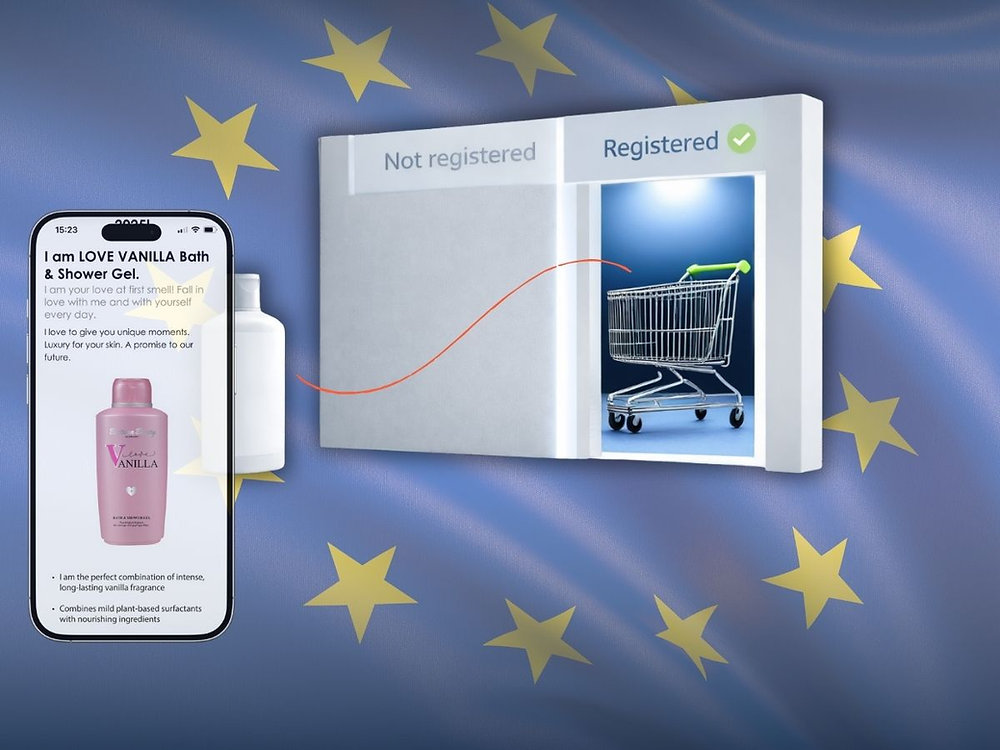
- All information relevant to a product is documented and stored along the entire value chain and anywhere in the world with just a few clicks. Without any extra IT infrastructure - existing hardware such as smartphones and PCs are sufficient.
- Via an invisible chip within the product (in the material, in the label, on a batch carton, etc.), all information is seamlessly fed in and can be displayed to the target group.
- A standard cell phone is required to read the information: simply hold it up to the product and the stories from the product and company history become visible via texts, images and videos. Transparency-relevant facts are credibly integrated, e.g. where and under what circumstances the pig, cow or chicken grew up, where the cotton for the T-shirt comes from, whether child labor can be 100% excluded or what the environmental balance of the cosmetics purchased looks like.
- The complete after-sales service (information on how to care for the product or new incentives to buy accessories or supplementary products) is also invisibly integrated into the product so that it is conveniently available to the customer at all times.
Wide range of needs of sustainable companies
My growing team and I were delighted at how quickly the first inquiries came in and how different the industries and needs of the companies were that contacted us: there is the large corporation from the fashion industry that wants to turn the topic of CSR and sustainability completely upside down internally. Or there's the traditional craft business that wants to show how meticulously and ethically prudent it works. Or the highly innovative manufacturer of convenience goods that not only wants to make its after-sales area significantly more cost-efficient, but above all consistently align it with the wishes of its customers.
Our story has only just begun. And it will produce countless stories, really good stories. We are all sure of that. Because not just talking about transparency, but showing it, proving it and bringing it to life - that is the challenge of the future and our absolute passion!