
 ·
11 minute read
·
11 minute read
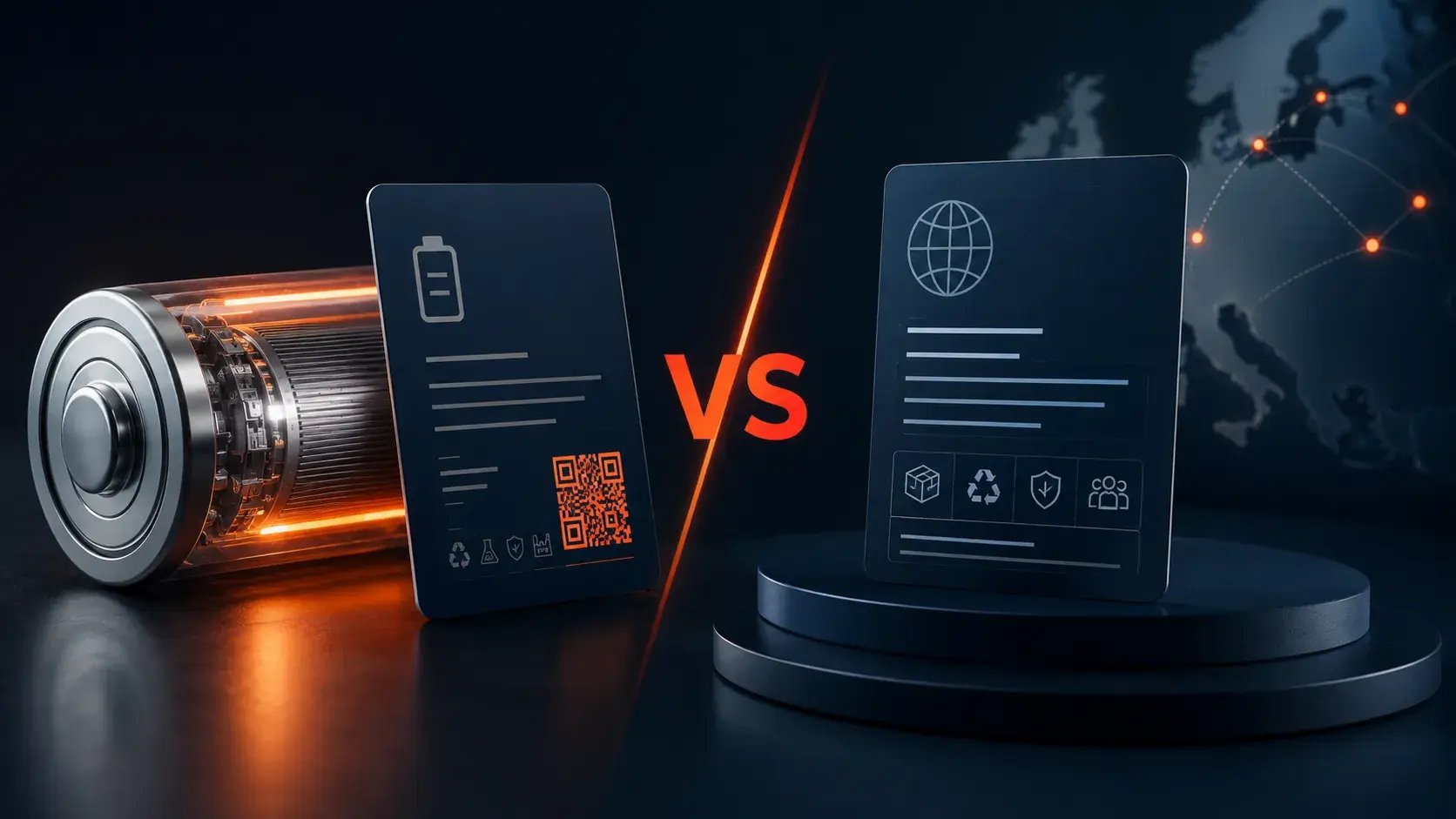
The question of battery passport vs. Digital Product Passport comes up for almost everyone entering a DPP project for the first time: are these two separate obligations, or is one the same as the other? The short answer is the most important one: the battery passport is not a competitor to the Digital Product Passport, but its first mandatory DPP variant within the EU regulatory framework. It is the sector-specific implementation of the Digital Product Passport for the battery categories covered by the EU Battery Regulation, with its own legal basis, its own deadline and its own data scope. Anyone who understands this plans compliance not twice, but once, correctly.
This article sorts both passports out cleanly: which regulation governs which passport, when each obligation applies, which data is required in each case and where the two overlap technically. The overall framework is provided by the main page on the Digital Product Passport, and the battery-specific depth by the article on the Battery Passport.
The most important point first: not either-or
The Digital Product Passport (DPP) is a machine-readable product identity that is uniquely assigned to a product and makes its data accessible across the lifecycle. It is set up as a horizontal framework in the Ecodesign for Sustainable Products Regulation (ESPR, Regulation (EU) 2024/1781) and is made concrete per product group.
The battery passport is the first mandatory DPP variant within the EU regulatory framework. However, it does not follow an ESPR delegated act, but the standalone EU Battery Regulation (Regulation (EU) 2023/1542) and applies to the battery categories covered there. Because the Battery Regulation was finalised earlier than the first ESPR acts, the battery passport is the passport that becomes binding first.
The "vs." in the title is therefore deliberately pointed. This is not about two competing systems, but about the relationship between framework and variant. In practice this means: anyone placing batteries on the EU market works on the battery passport first, but should understand it as part of the larger DPP logic, not as an isolated special obligation.
Key takeaway: The battery passport is the DPP for batteries, just with its own legal basis and an earlier deadline. Framework and variant, not competition.
Battery passport: the DPP for batteries
The battery passport is governed by the EU Battery Regulation and is therefore the most concretely specified DPP variant. Subject to a passport from are electric-vehicle batteries, industrial batteries with a capacity above 2 kWh, and LMT batteries, that is, batteries for light means of transport such as e-bikes and scooters.
The data scope is battery-specific: identity and manufacturer, material composition, performance and ageing data including state of health, and safety information. In addition, the battery passport can contain result data on the carbon footprint, recycled content and due-diligence findings. However, this result data is not mandatory across the board from 18 February 2027 for all affected batteries, but only once the specific requirement for the relevant battery category applies. For individual areas such as the carbon footprint and the due-diligence report, the start of the obligation also still depends on secondary legislation that provides for a transition period after its adoption. Importantly: the passport contains result data, such as a carbon-footprint declaration or a public due-diligence report, not the full raw supply-chain data. Concrete deadlines should be checked against the final applicable acts of the Battery Regulation.
A second point that is often underestimated in practice: for the battery categories subject to a passport, the battery passport applies per individual battery, not per model. Each battery subject to a passport gets its own passport with a unique identifier. That is a fundamentally different scaling case from one record per product variant.
Key takeaway: The battery passport has the earliest fixed deadline, the most comprehensive battery-specific data scope, and applies to every individual battery subject to a passport.
Digital Product Passport: the horizontal ESPR framework
The general Digital Product Passport is set up in the ESPR as a framework that is rolled out step by step to individual product groups. Unlike the Battery Regulation, the ESPR itself names no single deadline for everyone. Instead, the Commission sets a delegated act per product group that defines mandatory fields, data depth and transition period.
The European Commission's first ESPR working plan (adopted in April 2025) names six priority product groups: iron and steel, textiles, tyres, aluminium, furniture and mattresses. Iron and steel come first, followed by textiles, tyres and aluminium, then furniture and mattresses. Between the publication of an act and the obligation there is usually a transition period of 18 to 36 months. The order and transition periods reflect the current state of EU work and can still change with the final acts.
Above all this sits the central EU DPP registry, which on current understanding is expected to become available in phases from . In future it is intended to form the shared access and registration layer to which products subject to a passport are connected, regardless of which regulation their specific obligation comes from. The final technical design still depends on the implementing acts. On current understanding, the registry is not a central storage location for the full passport: the full data stays decentralised with the responsible economic operator or an authorised operator, while the registry mainly holds identifiers and high-level metadata. The deadlines by product group are covered in the article on the DPP deadlines to 2030, and the regulatory framework by the page on the ESPR Ecodesign Regulation.
Key takeaway: The ESPR DPP does not arrive all at once, but product group by product group through delegated acts with their own transition periods.
Battery passport vs. Digital Product Passport: the differences in detail
The following table compares the battery passport with the general ESPR product passport. It shows where the two passports differ, even though they follow the same underlying logic.
| Dimension | Battery passport | Digital Product Passport (ESPR) |
|---|---|---|
| Legal basis | EU Battery Regulation (Regulation (EU) 2023/1542) | Ecodesign Regulation ESPR (Regulation (EU) 2024/1781) plus delegated acts |
| Scope | EV, industrial (above 2 kWh) and LMT batteries | Product group by product group: iron/steel, textiles, tyres, aluminium, furniture, mattresses and more |
| Deadline | Fixed: 18 February 2027 (due-diligence obligations staggered) | No single date: per act plus 18 to 36 months of transition |
| Data scope | Identity, manufacturer, material composition, safety, performance and ageing data; carbon footprint, recycled content and due-diligence details only where and once the specific requirement applies | Defined per product group in the act (materials, repairability, recycling and more) |
| Granularity | Per individual battery | Model, batch or individual-item level depending on the act |
| EU registry | Central EU DPP registry | Shared European DPP infrastructure (incl. future EU DPP registry) |
| Responsible party | Economic operator placing the battery on the market | Manufacturer or importer of the relevant product |
| Maturity | Most concretely specified, first obligation | Framework in place, specification per product group under way |
The difference that most often surprises compliance teams is in the "Deadline" row. The battery passport has a hard, fixed date. For the ESPR DPP, the deadline depends on the relevant delegated act, which is not yet final for many product groups. Anyone waiting for "the one DPP deadline" is waiting for something that does not exist in that form.
Key takeaway: Same underlying logic, different details: the battery passport has a fixed date and deep data scope, while the ESPR DPP arrives in stages per product group.
Where the two passports overlap
However different the legal bases are, the technical foundation is largely the same. Both passports need a unique product identifier, a data carrier such as a QR code or NFC tag, a structured and machine-readable data model, and role-based access for end customers, authorities, service businesses and recyclers. The basic architecture building blocks are similar; the concrete data models, roles, access rights and evidence, however, depend on the relevant act.
This common ground is the real strategic point. The European standardisation bodies are working precisely on keeping the data models interoperable across sectors, so that the battery passport, textile passport and further variants do not emerge as separate silos. For a company working on the battery passport today, this means: the infrastructure built is not a single-use solution, but a reusable foundation; data models, roles, mandatory fields and evidence are adapted per product group.
Key takeaway: Identifier, data carrier, data model, role-based access and the EU registry are the same for both passports. Build them once and you are prepared for the next wave.
What this means for your compliance planning
In practice, the distinction can be translated into a simple sequence. It helps to keep the fixed battery deadline and the staggered ESPR deadlines cleanly separate, without doing the work twice.
- Clarify exposure per product line. For each product line, check whether it falls under the EU Battery Regulation, under an ESPR act or under both. Products with a built-in battery are the typical borderline case.
- Compare deadlines and data requirements. For batteries, the fixed deadline of 18 February 2027 applies; individual result data such as the carbon footprint and due diligence only take effect once specifically applicable. For ESPR products, wait for the product group's delegated act and plan for the transition period.
- Build on a shared infrastructure. Build a shared infrastructure for identifiers, data carriers, roles, registry connection and data management, so that the battery passport and later DPP variants can build on it.
What we see with customers in the battery and energy-storage sector: the battery passport is often the first concrete reason to invest in a DPP infrastructure at all. That is exactly why it is worth treating it not as an isolated battery obligation, but as a starting point. For more depth, see the industry page for battery and energy storage.
Key takeaway: Clarify exposure, compare deadlines, build on a shared infrastructure once. The battery passport is the entry point, not the end.
Battery passport and DPP in numbers
battery passport obligation for EV, industrial (above 2 kWh) and LMT batteries
Reg. 2023/1542
EU Battery Regulation as the legal basis of the battery passport
2026
planned start of the central EU DPP registry, in phases (on current understanding)
2 kWh
capacity threshold above which industrial batteries become subject to a passport
6
product groups in the first ESPR working plan (European Commission, April 2025)
81%
of affected companies without a DPP implementation plan (KPMG, Feb. 2026)
"81 per cent of affected companies still have no robust DPP implementation plan."
Key takeaway: The battery deadline is fixed, the registry is expected from 2026, and the ESPR waves follow. The majority of companies still have no plan.
Implementation with Narravero
Narravero operates an end-to-end DPP platform and provides the infrastructure with which companies create, operate and manage Digital Product Passports across the entire product lifecycle. More than 200 corporate customers across 12 industries use the platform, with more than 300 million platform interactions per month, EU-hosted and designed for GDPR-compliant processing.
For the question "battery passport or Digital Product Passport", it is precisely this common ground that matters. Narravero supports the implementation of the battery passport with its battery-specific data scope, including EV, industrial and LMT batteries, and is designed to use the same infrastructure building blocks for further DPP variants once the ESPR acts take effect. The infrastructure is reusable; data models, roles, mandatory fields and evidence are adapted per product group. Thomas Rödding, founder and CEO of Narravero, is personally involved in the European standardisation bodies for the Digital Product Passport, including CEN-CENELEC JTC 24 and DIN, in a personal capacity.
If you are unsure whether your product lines fall under the Battery Regulation, the ESPR or both, the free DPP Readiness Check gives a structured initial assessment in a few minutes.
Book a demo → Go to the DPP Readiness Check →
Key takeaway: One platform for both passports: the battery passport today, further DPP variants on the same foundation, adapted per product group.
Frequently asked questions
Is the battery passport the same as the Digital Product Passport?
Not quite. The battery passport is the sector-specific variant of the Digital Product Passport for batteries. It follows the EU Battery Regulation, while the general Digital Product Passport follows the ESPR. Same underlying logic, but a different legal basis, deadlines and data requirements.
From when does the battery passport apply?
From 18 February 2027 for electric-vehicle batteries, industrial batteries above 2 kWh and LMT batteries, where applicable. The supply-chain due-diligence obligations take effect on a staggered timeline; the exact date should be checked against the final applicable version of the regulation.
From when does the Digital Product Passport under the ESPR apply?
There is no single date. Each product group gets its own delegated act with its own transition period, usually 18 to 36 months. In the first working plan, iron and steel come first, followed by textiles, tyres, aluminium, furniture and mattresses. The order and deadlines can still change with the final acts.
Do I need both passports for my product?
For a single battery, the battery passport is enough. If your product contains a battery and the product itself falls under an ESPR act, both passports can become relevant, each for a different level of the product.
Which data does the battery passport require that the general DPP does not request by default?
The battery passport covers battery-specific information such as identity, manufacturer, material composition, and performance and safety data. Some details such as the carbon footprint, recycled content or a due-diligence report are only to be included as result data and become mandatory only once the specific requirement applies to the battery category; for some areas the secondary legislation is still pending. This is not automatically full supply-chain data in the passport. The general DPP defines its mandatory fields per product group in the relevant delegated act.
Does the battery passport apply per individual battery or per model?
Per individual battery, for the battery categories that are subject to a passport. Each battery subject to a passport gets its own passport with a unique identifier, not just one record per model.
Do the battery passport and the DPP use the same EU registry?
Both use the same basic DPP architecture principles and are intended to connect to the shared European DPP infrastructure. The central EU DPP registry is, on current understanding, expected to become available in phases from 2026 and to serve in future as an access point for products subject to a passport. On current understanding it does not store the full passport, but mainly identifiers and high-level metadata.
Can I implement the battery passport and the Digital Product Passport on one platform?
Yes. The basic architecture building blocks, namely a unique identifier, a data carrier and a connection to the DPP infrastructure, are similar for both; the concrete data models, roles, access rights and evidence depend on the relevant act. It makes sense to build the infrastructure once and adapt it per product group.
Does the battery passport also apply to individual modules or cells?
The passport obligation applies to the finished battery placed on the market. Individual modules or cells are only subject to a passport if they are themselves placed on the market as a battery for end use.