

Fundamentals · EU regulation 2027
Digital Product Passport: obligation, requirements and strategic opportunity from 2027
From 2027 the Digital Product Passport becomes a market access requirement for almost every physical product on the EU market. Only 19 per cent of companies are well prepared for it. The window is tighter than the deadlines suggest.
The Digital Product Passport (DPP) becomes a market access requirement for almost every physical product on the EU market from 2027. The legal basis is the Ecodesign for Sustainable Products Regulation (ESPR), complemented by sector-specific legal acts such as the EU Battery Regulation. According to the KPMG European DPP Readiness Survey, only 19 per cent of affected companies are well prepared for the DPP. The first deadlines are already running. This page shows what that means in practice, which sectors are affected when and what to do now.
The DPP by the numbers
19 %
well prepared for the DPP
KPMG European DPP Readiness Survey
18.02.27
battery cut-off date
Reg. 2023/1542
90+
data points
Reg. 2023/1542, Annex XIII
6-12
months to implement
Narravero experience
What is the Digital Product Passport?
The Digital Product Passport is a machine-readable, digital product identity at individual-item level. It holds structured data on the origin, material composition, repairability, carbon footprint and end of life of a physical product. The DPP is not a marketing document, not a label and not an extended product page. It is a regulatory-recognised infrastructure that is uniquely assigned to each product and remains accessible across the entire lifecycle. The legal basis is the Ecodesign for Sustainable Products Regulation (ESPR), the horizontal EU framework that introduces the DPP for almost every product category. The first sector-specific implementation is the Battery Passport based on the EU Battery Regulation, mandatory from .
A useful analogy: the DPP is a digital life record per product. It grows with the product over its entire useful life, is updated on repair, resale or certificate change, and gives every authorised actor the relevant section. Not a static specification, but a continuously maintained data set.
DPP vs product page: the fundamental difference
A product page (PDP) in a web shop is a marketing asset without a standardised data model. It addresses everyone and is the same for everyone. The DPP is structurally different:
| Landing page / product page (PDP) | Digital Product Passport (DPP) |
|---|---|
| No unique product identity, one model page for all units | Unique identifier per individual product or batch |
| No standardised data model | Structured, machine-readable, EU-conformant |
| All visitors see the same information | Role-based access: customer, authority, technician |
| Static snapshot, no versioning | Grows with the product, fully versioned |
| No interface to authorities or registries | EU registry connection to technical specification |
Both elements can be accessible through the same QR code, but they serve fundamentally different purposes. Anyone who designs the DPP as an extended product page misses the regulatory requirements and the strategic opportunity at the same time.
Key point The DPP is product identity, compliance evidence and communication channel in one, across the entire product lifecycle.
Digital Product Passport obligation: which sectors and when?
The mechanism of the Digital Product Passport regulation is consistent. The EU Commission adopts a Delegated Act for a product category. From the publication of that act, a transition period runs, usually around 18 months, though it can be shorter or longer depending on the act. After that, the DPP is mandatory for every new product placed on the EU market. Existing products already on the market are initially exempt; new goods are not. Alongside this, several sector-specific regulations (PPWR, Construction Products Regulation, Toy Safety Regulation, Detergents Regulation) carry their own DPP obligations that are not activated via a Delegated Act but come directly from the respective regulation.
For batteries the deadline has been set since February 2024: is the date from which industrial batteries, vehicle batteries and certain device batteries require a valid DPP. Anyone only starting to plan today has no room left for this category. In practice, implementing a DPP infrastructure takes between six and twelve months.
For the ESPR product categories the Delegated Acts run in stages. The ESPR Working Plan of April 2025 sets the prioritised product categories. On the logic: the date in the third column shows when the respective Delegated Act is expected to be adopted. The DPP obligation usually applies around 18 months later; the actual transition period can be shorter or longer depending on the act. Example textiles: Delegated Act expected 2027, DPP obligation 2028/2029. Other sectors are not regulated via ESPR acts but directly via sector-specific regulations (Battery Regulation, PPWR, Toy Safety Regulation). The timings are based on current EU legislation and may shift backwards, not forwards.
| Sector | Regulation | Del. Act expected | DPP obligation |
|---|---|---|---|
| Batteries | EU Battery Regulation | directly regulated | 18 February 2027 (fixed) |
| Textiles and fashion | ESPR | 2027 | 2028/2029 |
| Electronics / ICT | ESPR | 2027 | 2028/2029 |
| Household appliances | ESPR | 2027 | 2028/2029 |
| Mattresses | ESPR | 2027/2028 | 2029 |
| Tyres | ESPR | 2027/2028 | 2029 |
| Furniture | ESPR | 2028 | 2029/2030 |
| Iron, steel, aluminium (intermediate products) | ESPR | 2028/2029 | 2030/2031 |
| Packaging | PPWR (digital label) | directly regulated | 2028/2029 |
| Detergents | Detergents Regulation | directly regulated | September 2029 |
| Construction products, cement | Construction Products Regulation (CPR) | directly regulated | 2029/2030 |
| Toys | Toy Safety Regulation | directly regulated | August 2030 |
Sources: European Commission ESPR Working Plan (April 2025), EUR-Lex EU Battery Regulation
A common misconception: those not in the first wave have no urgency. That is wrong. Anyone in the second or third wave has more time until the obligation, but the same implementation time. A company that must be compliant in 2028 and starts in 2027 has just enough time. A company that starts in 2026 has time for a strategic build.
Sector-specific entry points with concrete requirements and examples are available for battery and energy storage manufacturers, the textile and fashion industry, the furniture industry and the electrical and electronics industry. The Ecodesign Regulation as the regulatory framework is covered by the ESPR page, and the sector-specific implementation for batteries by the digital Battery Passport.
Key point Batteries are fixed from February 2027, ESPR sectors follow in stages through to 2030. Start in 2026 and you have buffer; start later and you do not.
Are you affected?
If you sell physical products on the EU market, you are affected. That applies regardless of the sales model, the company size and whether the products go to end customers or business customers.
The regulation does not distinguish by sales channel. What matters is who places the product on the EU market: the manufacturer, importer or authorised representative bears responsibility for the valid DPP. Retailers that list products without a valid DPP become jointly responsible from the cut-off date. That includes platforms such as Amazon and wholesale partners.
Quick check
Three questions to position yourself:
- Do you sell physical products in the EU?
- Are you a manufacturer, importer or retailer?
- Do your product categories fall under ESPR or the EU Battery Regulation?
Anyone answering all three with yes is affected. The only open question is the timing.
Key point Anyone placing physical products on the EU market is affected. Company size, sales channel and B2B/B2C make no difference.
Which data must the DPP hold?
The DPP is not free text and not a PDF. The data points are defined by regulation, product-specific depending on the regulation and product category. What a Battery Passport must contain differs from a textile DPP, which in turn has different requirements from a furniture DPP. Even so, there is a common data base that all DPPs share.
01
Material composition
Wood types, coatings, adhesives, SVHC substances under REACH. For batteries: cell chemistry, raw material origin for cobalt, lithium, manganese.
02
Origin and supply chain
Raw material origin, production sites, documented transport routes. Not as self-declaration, but as verified data.
03
Repairability
Available spare parts, repair instructions, service infrastructure. For household appliances: repairability score under the EU methodology.
04
Carbon footprint (PCF)
Product Carbon Footprint across the entire lifecycle, calculated to the GHG Protocol. Not an estimate, but a verifiable data point.
05
Recycling information
Separability, end-of-life handling, collection points. With linked resources for service technicians and recyclers.
06
Certificates and compliance
Standards met, testing bodies, certificate status with expiry dates and automatic updating.
Mandatory data vs voluntary data
Not all data points are mandatory by regulation, but the line between obligation and option is strategically relevant. Anyone who supplies only the minimum data is compliant. Anyone who adds further value data, such as warranty information, care instructions or resale certificates, activates the business-value side of the DPP. A platform must be able to separate both cleanly: mandatory data fields that are checked by regulation, and optional fields that drive customer value.
Who may see which data?
Role-based data access is not a technical feature, it is required by regulation. The EU regulation explicitly distinguishes between data that must be publicly accessible and data that is only visible to authorised bodies. The following matrix shows the basic structure:
| Role | Sees in the DPP | Access path |
|---|---|---|
| End customer | Value information: care, warranty, repair, resale value | QR code or NFC tag, no login needed |
| Authority, market surveillance | Full compliance data, certificates, test evidence | EU registry access, authenticated |
| Service technician | Installation history, spare parts, wiring diagrams, error logs | Technician login or QR with role detection |
| Supplier, partner | Production data, quality evidence, certificate status | Partner portal, role-bound |
The structure is technically demanding. Anyone working without a clear platform architecture quickly builds up complexity that can no longer be unwound later. Point solutions rarely reach this depth.
How does the DPP work technically?
The technical idea is simple: one physical object, one digital identity, accessible at any time. The complexity is not in the access, but in the infrastructure behind it. That is exactly where it is decided whether a DPP solution is genuinely compliant or only looks the part.
QR code or NFC tag?
Both technologies are permitted by regulation. In practice the QR code dominates today: cheap, printable on any existing label, readable with any smartphone without additional hardware. For textiles and fashion the QR code is the obvious choice.
NFC tags offer advantages for products where physical robustness matters: industrial components, premium consumer goods, products with a long lifespan. They allow contactless reading without a camera and are more tamper-resistant. For batteries and electronics NFC tags are increasingly standard. The decision is not a design question but a product-category decision.
The EU registry
Every DPP must be registered in the central EU registry. That is not an optional requirement. The registry ensures that market surveillance authorities across Europe can access product data, that duplicates and counterfeits are detectable, and that data consistency is guaranteed across the product lifecycle.
Milestone
From the EU Commission brings the registry into production. From that date, real and fake product passports can be told apart systematically. Passports submitted earlier are migrated into the new registry.
EU registration requires that the DPP platform used meets the EU Commission's technical specifications, including standardised data interfaces to GS1 and ECLASS. In-house builds without a native connection are not fully compliant by regulation, even if they deliver a QR code and a data page.
Important for practice: EU registration is not a one-off act. Across the product lifecycle, data is updated: new certificates, changed materials, repair history, end-of-life status. This is an operation, not a project. Anyone who does not factor this in when comparing platforms significantly underestimates the ongoing effort of an in-house build.
Key point The EU registry from July 2026 is the technical criterion on which low-cost solutions without a native connection fail.
The DPP as the third infrastructure shift
To understand why the Digital Product Passport in 2027 is more than a new compliance requirement, a historical comparison helps. The DPP will not be as far-reaching as the internet itself. But for the sub-domain of product information it can have a standardising effect comparable to what the barcode did for the flow of goods or HTTP for digital information flows. It is a paradigm shift for product data, not for the world.
1974
Shift 1
Barcode
Made physical products readable for machines. Fundamentally changed logistics and retail.
1991
Shift 2
HTTP
Made information globally accessible. Triggered a wave of digital business models.
2027
Shift 3
DPP
Every product receives a structured, machine-readable digital identity at individual-item level.
Anyone who sees this shift only as an obligation will only meet it. Anyone who sees it as infrastructure builds business models on top of it.
The EU has set out the logic of the shift clearly. Under the principle "one tool, digitise once", the Commission interlocks 30 ongoing legislative initiatives with the DPP as a unified data infrastructure. In February 2026 the DPP was additionally linked to the New Legislative Framework and the Data Labelling Infrastructure of the European Patent Academy. This is not a loose compliance topic, but a coordinated overhaul of regulatory infrastructure.
19 %
of the companies surveyed are well prepared for the Digital Product Passport, meaning with clear roles, a roadmap and a C-level sponsor.
This is not a panic number, but a frame. Anyone who starts early builds not only compliance but, in parallel, the service, sales and customer-relationship value that is hard to catch up on later. Anyone who waits misses, in the first instance, not a deadline but the product-level levers that emerge from the same data infrastructure.
The Battery Passport is the prototype. What is built there in architecture, governance and data quality can be transferred to further product groups as soon as ESPR acts follow for textiles, furniture or electronics.
Key point The DPP is infrastructure, not obligation. Anyone who sees it as infrastructure builds business models on it instead of compliance costs.
From compliance project to business value
Compliance is the entry ticket, not the return. Anyone who builds the DPP purely to meet the obligation pays the implementation cost and unlocks none of the strategic advantages. Anyone who builds it as infrastructure refinances the compliance through measurable business value.
Scenario 01
Owned channel
A manufacturer sells its product via Amazon, through specialist retail, via distributors. The first purchase happens, but after that nothing does. The manufacturer does not know who bought the product, how it is used or when a repeat purchase would be likely. This structural data loss has been reality for manufacturers of physical products for decades.
If the buyer scans the QR code on the product, for warranty registration, for a care guide or to order a spare part, that changes fundamentally. The manufacturer has direct access to its customer for the first time. No intermediary, no platform fee, no data loss to Amazon or Google. Every scan is a first-party data point that flows straight into the CRM.
"For us the DPP is an indispensable 24/7 customer adviser inside the product."
DIRK UHLENBROCK · MANAGING DIRECTOR, B&W INTERNATIONAL
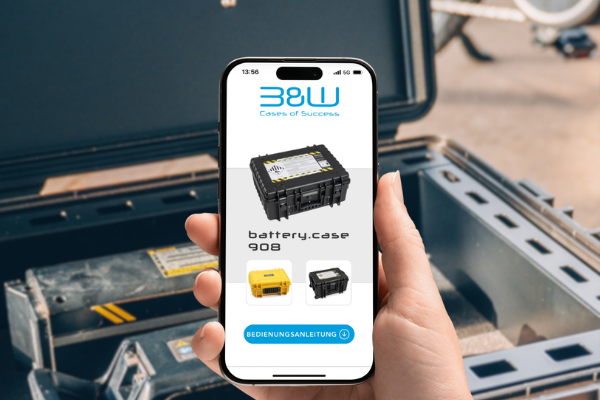
B&W International makes specialist cases and transport solutions for professional applications. There the DPP is the direct line to the customer after the first purchase: product registration, warranty handling, spare-part ordering, customer communication, all through one scan on the case, with no detour via retail or Amazon.
Scenario 02
After sales
A service technician stands in front of a machine. They need the serial number, the installation history, the right spare part and the contact details of the manufacturer's service. Today: three systems, a manual they cannot find, a call to support. With a DPP: one scan on the product, all data available instantly. Maintenance history, part numbers, direct ordering link.
This is not only a service-efficiency topic. It is a revenue topic. Every spare-part order that runs directly through the DPP instead of through retail is direct revenue. Every warranty extension triggered on the product is existing-customer revenue without acquisition cost.
Every after-sales scan additionally generates usage data that today lands in no system. When is the product actively used? Which component is replaced first? This data flows in real time into the analytics dashboard and directly into product-development and sales decisions.
Scenario 03
AI readiness
Amazon Business, SAP Ariba, Mercateo and other B2B procurement platforms are fundamentally changing how purchasing decisions are made. AI-driven systems take over the pre-selection and filter by data completeness, machine readability and data quality. A product without a structured DPP drops out of this pre-selection before a human is involved.
That already applies today, not in a hypothetical AI future. Purchasing systems based on structured product data are already in use in large companies. Anyone who builds a DPP in 2027 that only meets the minimum requirements has not designed for AI readiness.
Another scenario already becoming reality today: the second-hand market. Platforms such as eBay, Back Market and specialised B2B resale marketplaces increasingly assess products by verifiable quality and origin. A product with a complete, verifiable DPP achieves measurably higher prices than an identical product without this data base.
"You can do the DPP on a shoestring, or you can really show the value."
LEO LUEBKE · OWNER AND CEO, COR
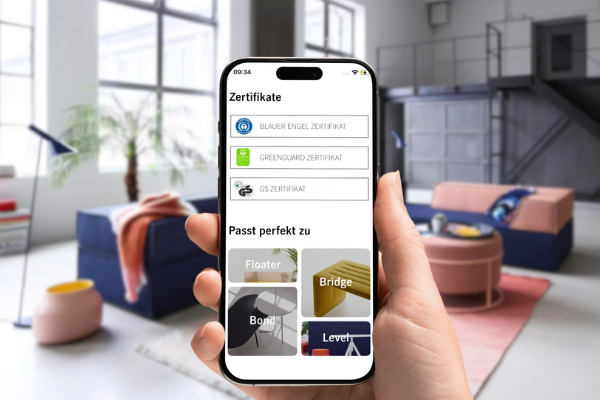
COR is a furniture manufacturer in the premium segment. Furniture falls into the ESPR wave of 2028/2029; COR started earlier. There the DPP is positioned as quality evidence and an after-sales channel: material certificates, care information, spare-part ordering, repair service. Compliance comes as a by-product, not as the driver.
Early starter as benchmark: SEINE battery systems
3 years before the obligation
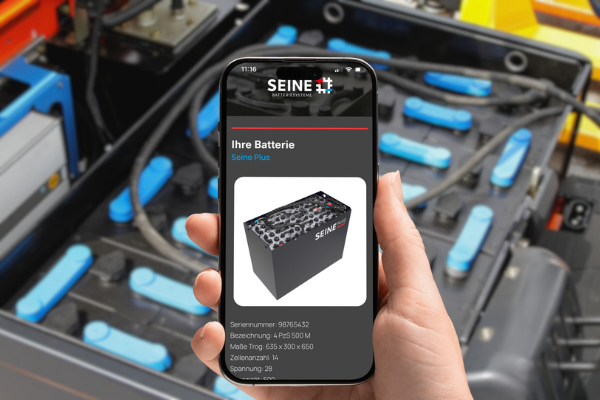
SEINE has been building industrial battery systems for over 45 years and started building its DPP back in 2023, around three years before the Battery Passport obligation. Today all of the manufacturer's intralogistics batteries are equipped with a DPP.
In after sales, a QR scan replaces the classic identification: via a push-to-action button the technician receives the technical data directly and knows which spare parts to bring. During technology changes the DPP provides full transparency on cells, supply chain and hazard potential. Recycling becomes a resilience lever against raw-material dependency on rare earths.
The pattern is instructive: anyone who starts three years before the obligation builds a data infrastructure that, when the regulation takes effect, is not only compliant but already producing business value. That is the practical flip side of the KPMG figure that only 19 per cent of companies are well prepared.
More DPP implementations in practice
Six customers from different sectors already using the Digital Product Passport in production today. Premium furniture, handmade shoes, specialist cases, industrial batteries, optics and more. Each case study shows concrete implementation paths and solid business effects.



Key point Compliance is the entry ticket, not the return. Owned channel, after sales and AI readiness refinance the project.
The Digital Product Passport and the circular economy
The ESPR is at the heart of the EU Circular Economy Action Plan. The Digital Product Passport is not a by-product here but the tool that makes circularity demonstrable in commercial terms in the first place. Without structured individual-item data, the circular economy remains a statement of intent.
Three concrete levers interlock:
Repair instead of replacement
The DPP gives service technicians and end customers information on spare parts, repair instructions and the repairability score. It lowers the barrier to repair and extends the useful life.
Reuse and resale
The DPP travels with the product into the second-hand market. Buyers see material composition, maintenance history and proof of authenticity. The basis for certified resale and refurbishment.
Recycling and material recovery
Disassembly instructions, sorting notes and material compositions are stored in the DPP in structured form. Recyclers scan, separate precisely and raise recycling rates measurably.
The economic consequence: companies that build the DPP as a pure compliance project deliver the data but switch on none of the circularity levers. Anyone who understands the DPP as infrastructure anchors the circular economy in the business model.
Key point Without structured individual-item data, the circular economy remains a statement of intent. The DPP makes it operationally demonstrable.
The business case: the DPP as value-creation infrastructure
Up to here we have looked at the DPP from an operational angle: compliance, data structure, service, circularity. At board and marketing level a different question arises: what does the DPP do to the economic value of a product and a brand?
The answer is uncomfortable for companies that build their brand today exclusively through media spend, and full of opportunity for companies willing to think of the product itself as brand infrastructure. The DPP changes three strategic variables at the same time.
The product becomes a lifetime asset, not a transaction point
Classically the brand relationship with a product ends at the checkout. After that, Amazon reviews, service providers or second-hand platforms take over the communication. The manufacturer loses visibility, data sovereignty and the emotional connection it paid media budget to build.
With the DPP the product remains an addressable channel across the entire lifecycle. Every scan delivers a brand-bound touchpoint: at product registration, at the care guide, at spare-part ordering, at repair, at resale. This is not media budget, it is infrastructure. The cost arises once, the touchpoints scale with every product sold.
Second-hand market: from blind spot to controlled brand channel
The second-hand market is a growing store of value for premium and mid-range brands, but one that third parties have controlled so far. Back Market, eBay, Rebuy and specialised B2B resale platforms set price levels, authenticity standards and customer experience. The original manufacturer is a supplier of its own used goods, with no entry into the value creation.
The DPP changes this logic structurally. A product with a complete, verifiable data history (materials, maintenance history, proof of authenticity, repair records) achieves measurably higher prices on existing resale platforms than an identical product without this data base. More interesting still: the manufacturer can set up its own second-hand offers, run certified refurbishment programmes or steer resale partnerships with defined price corridors. That protects the primary market from price erosion and at the same time opens up a second revenue source.
For brands with high emotional attachment this becomes a strategic lever in its own right: the second use of the product becomes part of the brand narrative, not its counterpoint. A case that lasts 15 years and is passed on with a documented history is a stronger brand signal than any advertising. This is exactly where the three scenarios in module 8 connect; here it turns into a line item you can put on the balance sheet.
The product as a medium: brand building beyond ads
Brands with high emotional customer loyalty command significant price premiums over competitors with identical functionality. That has been a standard finding of brand research for decades. What is new: the classic mechanics of this loyalty (brand communication via paid media, earned media, owned channels in the sense of website and social) are under pressure. Paid media gets more expensive, earned media fragments, owned channels compete with algorithms.
The physical product remains the only brand touchpoint the manufacturer fully controls. With the DPP this touchpoint becomes digital. Origin, craft, values, sustainability, materiality, all of it can be told on the product, right where the customer is looking anyway. No intermediary layer, no platform fee, no algorithmic dilution. This is the infrastructure on which brand strategies develop that carry beyond impressions and reach.
Impulse paper for CEO & CMO
Brands don’t live in ads
A strategic impulse paper for the board and marketing leadership. How the Digital Product Passport translates into price premium, customer loyalty and second-hand-market control. With case examples from fashion, furniture and consumer goods.
The economic logic in summary: compliance is the trigger that finances the DPP. Circularity is the regulatory context that justifies it. Value creation is the reason a CFO backs the project rather than merely co-funds it. Anyone who leaves the pillar page at this point has understood the three altitudes of decision-making: operational efficiency, environmental responsibility, strategic brand value.
Key point The physical product remains the only brand touchpoint the manufacturer fully controls. The DPP makes it digital and addressable.
The 5-step roadmap
The regulatory deadlines sound far away, but in production and IT project cycles they are tight. The following five steps give a pragmatic framework for becoming operational in the next 9 to 12 months.
Clarify whether you are affected
Which products do you place on the EU market? Which product categories fall under ESPR or the Battery Regulation? What role do you take (manufacturer, importer, authorised representative)? Result: a product list with clear mandatory requirements and cut-off dates per category.
Map your data landscape and work iteratively
Which mandatory data points sit where today (ERP, PIM, PLM, with suppliers)? Which are missing? Typical result: 40 to 60 per cent are somewhere available but fragmented. 20 to 30 per cent are missing entirely and must be sourced from the supply chain. Proven practice: break it into four tranches of 25 data points each, instead of tackling all 90+ at once.
Set up carbon footprint and material data
Methodologically to PEFCR or the GHG Protocol, technically to EU specification. Pilot early with selected products, an iterative approach rather than a big bang. Allow 4 to 6 months of lead time before reliable values are available.
Make the platform decision
Point solution or platform? Criteria: EU hosting, GDPR compliance, interfaces to ERP, PIM, PLM and MES, role-based access, horizontal standardisation to JTC 24. Anyone who opts for a pure sector solution today pays twice in the next ESPR wave.
Pilot before rollout
Start with one product group or one plant. Learn the data flows before you scale. Goal of the pilot: a production-ready DPP for one SKU, end to end, with real data.
The order matters. Anyone who starts with the platform selection before the exposure is clear makes a long-term decision blind. Anyone who starts with data capture before it is clear what is even required produces wasted effort.
Implementing the Digital Product Passport with Narravero
Narravero operates a product-data infrastructure that translates regulatory requirements into strategic competitive advantage. Over 200 enterprise customers from 12 sectors use the platform. It processes 300 million DPP accesses per month, hosted in the EU and fully GDPR-compliant. Narravero is a GS1 Solution Partner and was recognised in 2025 with the Global DPP Excellence Award.
What makes the difference: the platform is built so that the Battery Passport, ESPR product passports and existing traceability requirements run on one infrastructure. Founder and CEO Thomas Roedding is Co-Chair of CEN-CENELEC JTC 24, Vice Chairman at DIN and, since spring 2026, active in the newly constituted ISO/IEC JC5, the global standardisation joint committee for the Digital Product Passport with around 50 participating nations.
The typical implementation process with Narravero begins with a DPP readiness analysis: which data points are required by regulation? Where do they sit today, in ERP, PIM or with suppliers? What is still missing? From that emerges a concrete data plan that forms the basis for DPP creation, EU registration and go-live.
If you are currently working on your DPP roadmap, the fastest next step is a 30-minute demo call. Not a pitch session, but a professional assessment of your situation with one of our consultants.
Frequently asked questions about the Digital Product Passport
What is the Digital Product Passport?
The Digital Product Passport is a machine-readable, digital product identity at individual-item level. It holds structured data on origin, material composition, repairability, carbon footprint and end of life, accessible via QR code or NFC tag and connected to the central EU registry.
When does the Digital Product Passport become mandatory?
For batteries the date is 18 February 2027, fixed and enshrined in law. For textiles, electronics and household appliances it follows in 2027 to 2028, for furniture in 2028 to 2029 and for construction products in 2029 to 2030. The specific deadline in each case runs from the publication of the EU Commission's Delegated Act for the respective product category.
What is the difference between a DPP and a product page?
A product page is a marketing asset without a standardised data model. No unique identifier, no EU registry connection, no versioning. The DPP is a regulatory-recognised, machine-readable product identity with structured data points, role-based access and EU registry connection. Both can be accessible through the same QR code, but they are fundamentally different systems.
Does the DPP also apply to B2B products?
Yes. The DPP applies to all physical products placed on the EU market, regardless of whether they go to consumers or business customers. The regulation does not distinguish by sales channel. Industrial products, components and semi-finished goods can also fall under the DPP obligation, provided the respective product category is regulated.
What happens if a company has no DPP?
Without a valid DPP, affected products may no longer be placed on the EU market from the respective cut-off date. This is not merely a fines risk but a loss of market access. Retailers and platforms will enforce the requirement as a condition for listings before authorities even become active.
Who issues the DPP?
The manufacturer or economic operator placing the product on the market is legally responsible. They can outsource creation, EU registration and lifecycle management to a specialised DPP service provider such as Narravero. The regulatory responsibility stays with the operator; the operational delivery can be fully delegated.
How long must the DPP remain available?
For the entire product lifetime and beyond. That includes the second-hand market, the repair phase and the recycling phase. A DPP that is deleted after the first purchase, or whose hosting ends after a few years, does not meet the regulatory requirements.
Does the DPP also apply outside the EU?
The DPP is an EU obligation for products placed on the EU market. Non-EU manufacturers exporting into the EU are just as affected as EU manufacturers. Building to EU conformity also covers around 70 per cent of the emerging requirements in China and the United States.
Can I build the DPP on my existing systems?
Existing systems (ERP, PIM, PLM) supply parts of the required data but are not built for DPP logic. A PIM manages the current sales status at model or variant level. The DPP requires documentation at individual-item level across the entire product lifetime, with audit security, registration in the EU registry and role-based delivery. The ESPR obligation to provide a facility identifier (factory identifier per production site, per individual product) alone exceeds PIM data logic. Existing systems are integrated into a DPP infrastructure; they do not replace it.
What does a DPP cost?
Costs vary considerably by approach. What matters is not only the implementation cost but the ongoing cost of hosting, EU registration, compliance updates and lifecycle management over 10 to 15 years of product lifetime.
How long does DPP implementation take?
In practice the implementation time for a complete DPP infrastructure is between six and twelve months, depending on data availability, the number of product categories and supply-chain complexity. In most cases the critical path is not the technology but the data sourcing.
DPP meaning in brief?
DPP stands for Digital Product Passport. It is the standardised, machine-readable data structure that a physical product in the EU will have to carry. Its meaning goes beyond compliance: the DPP is product identity, communication channel and data infrastructure at the same time.
Next steps
You now have the overview. Three possible next steps, depending on where you stand:
01 · Scoping
Structure for getting started
You want to set the topic up in your company in a structured way. The whitepaper delivers the complete implementation guide with a checklist.
Download the whitepaper →02 · Regulation
Go deeper on the legal basis
You want to understand ESPR or the Battery Regulation in detail, including the mechanism of the Delegated Acts.
ESPR regulation → Battery Passport →03 · Implementation
Start right away
You want a professional assessment of your situation and to develop a roadmap.
Book a demo →