
 ·
11 minute read
·
11 minute read
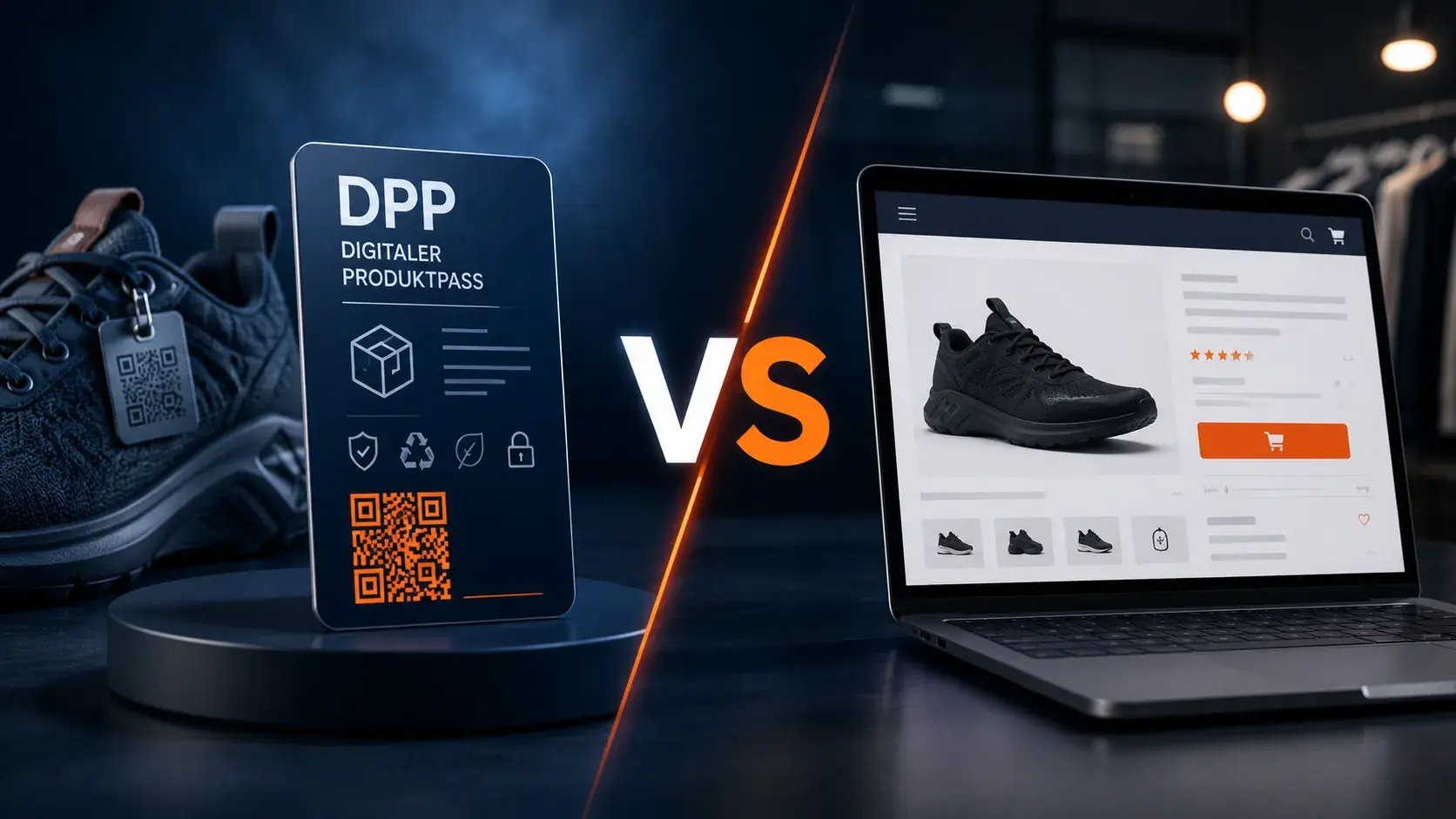
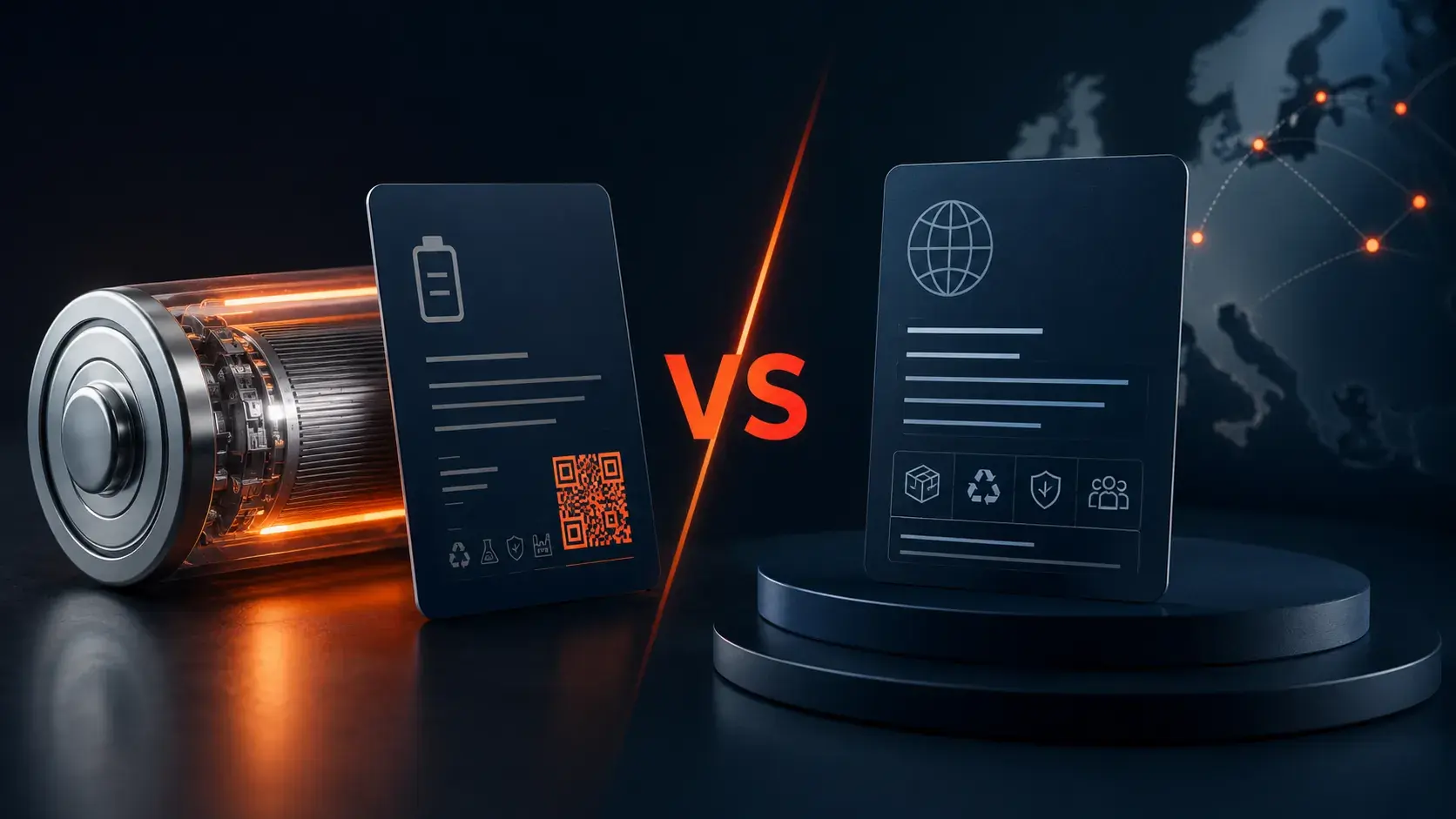
The question of DPP vs. product page comes up in almost every first conversation: "We have had a product page per item for ages, with a data sheet, care instructions and a QR code. Isn't that already the Digital Product Passport?" The short answer is no. A product page and a Digital Product Passport look similar on a smartphone, but they are two fundamentally different systems. The product page is primarily a sales and communication instrument. The Digital Product Passport is a regulatorily recognised, machine-readable product identity with a data model, role-based access and alignment with the European DPP infrastructure and, where provided, a link to the planned EU DPP registry. Anyone who confuses the two risks not meeting the requirements from the relevant deadlines and, at the same time, gives away the strategic opportunity. And this is exactly where the expensive misunderstanding sits: many companies believe that their existing product page already covers the DPP.
This article shows you where exactly the difference lies, what that means concretely for your product, your IT and your marketing, and how the DPP and the product page work together without doubling your work.
The difference in one sentence
The product page describes a product model for people. The Digital Product Passport describes, depending on the product group, an individual item, a batch or a model for people, machines and authorities in line with EU rules. Everything else follows from that one sentence.
A product page in your webshop, your data sheet as a PDF or your retailer's landing page represents a model: "This is what our product looks like, these are the features, this is the price." Every unit shares the same page. The DPP has, depending on the product group, a unique identity at model, batch or individual-item level. It knows which specific unit it represents, which certificates are attached to exactly that unit and who is allowed to see which data.
Key takeaway: The product page describes a model for people; the DPP describes, depending on the act, an individual item, a batch or a model for people, machines and authorities.
What is a product page (PDP)?
The product page, called the PDP (Product Detail Page) in e-commerce, is primarily your sales and communication instrument on the digital shelf. It answers the question "Why should I buy this?" and is driven by the conversion goal. Copy is emotional, images are polished, features are prioritised by relevance to the purchase decision. A PDP is publicly accessible via a URL and the same for all visitors.
Typical components of a product page are the product description and unique selling points, hero images, price information, variants, reviews, cross- and upsell modules and SEO metadata. In some industries this is complemented by a data-sheet download, a care instruction or a video. The technical basis is a content management system or a shop platform such as Shopify, SAP Commerce or HubSpot CMS. The data model is proprietary and shaped by your marketing team, not prescribed by the European Commission.
Importantly: a product page is not a compliance artefact. It fulfils no regulatory obligations on material composition, carbon footprint or repairability. It can contain this information, but it does not have to, and if it does, then in a form and depth you decide yourself.
Key takeaway: The product page is a freely designed marketing asset with no regulatory obligation, optimised for the purchase decision.
What is the Digital Product Passport (DPP)?
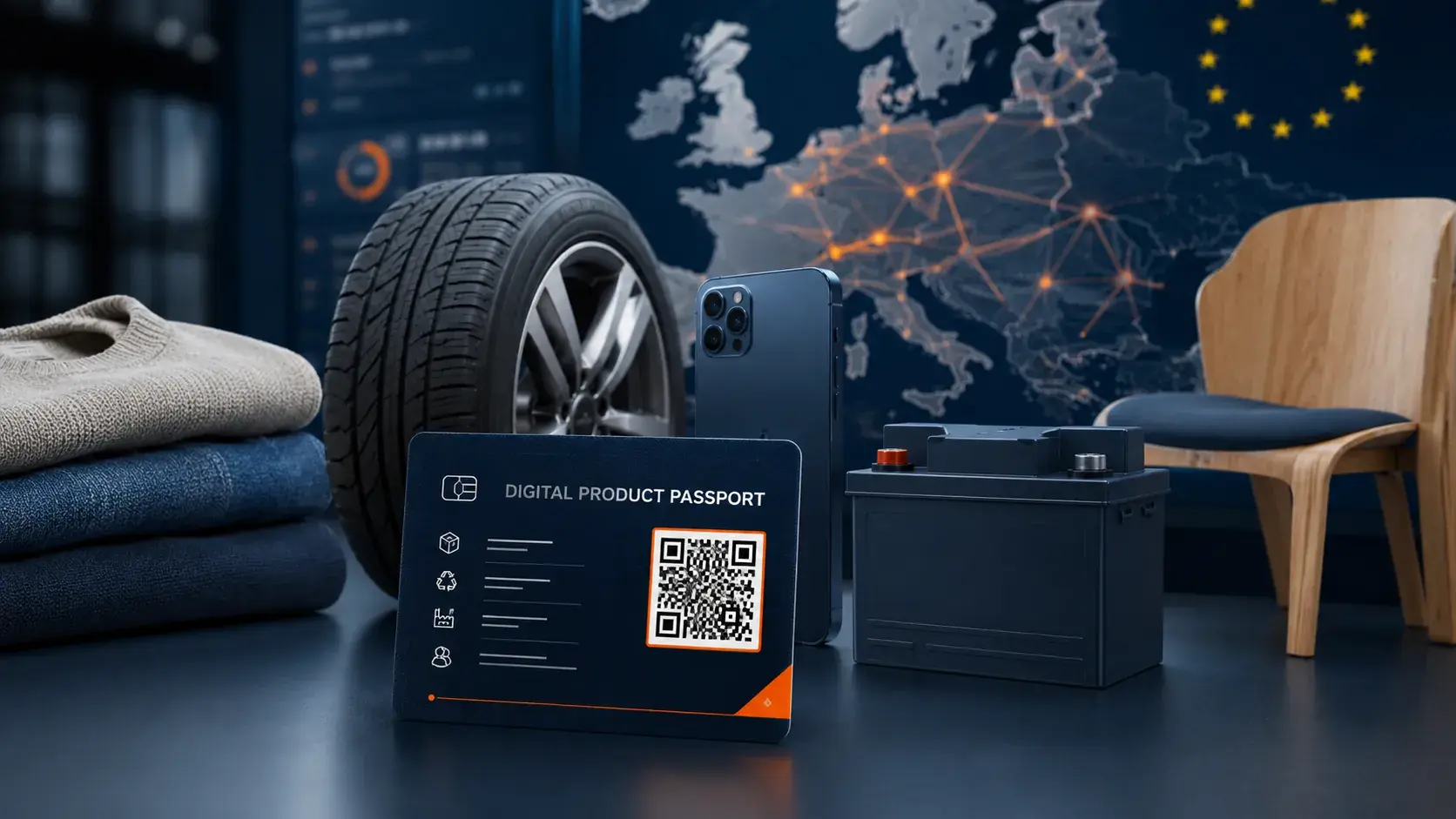
The Digital Product Passport (DPP) is a machine-readable, digital product identity that, depending on the act, is set up at individual-item, batch or model level. It is uniquely assigned via a unique identifier and is permanently available or updatable as the relevant act requires. The legal basis is the Ecodesign for Sustainable Products Regulation (ESPR, Regulation (EU) 2024/1781), complemented by sectoral acts such as the EU Battery Regulation (Regulation (EU) 2023/1542).
Depending on the product group and the act, a DPP can contain structured data in line with EU rules, including material composition (with SVHC substances), origin and supply chain, repairability, recycling information or certificates. Result data such as the carbon footprint is added where and once the specific requirement applies. The data is available in machine-readable form, not as running text in a CMS. Standards and data models such as GS1 or ECLASS support the interoperable processing of product data, so that procurement systems, market surveillance and recyclers can use it in an automated way.
Two features clearly set the DPP apart from a product page: role-based access and alignment with the European DPP infrastructure. End customer, authority, service technician and retailer each get different data layers, even though they scan the same QR code. The DPP is also designed for the shared DPP infrastructure and, where provided, a registry link; the central EU DPP registry is, on current understanding, expected to become available in phases from . It mainly holds high-level metadata and identifiers, while the full data stays decentralised. The concrete implementation depends on the relevant acts and technical specifications. More on the regulatory logic behind it in the overview of the ESPR Ecodesign Regulation and in the main article on the Digital Product Passport.
Key takeaway: The DPP is a regulatorily defined product identity with a unique identifier (at individual-item, batch or model level depending on the act), role-based access and, where provided, a registry link.
DPP vs. product page: the comparison table
The following table summarises the differences systematically. It is the short answer to the question of whether you cannot simply upgrade the existing PDP for your product.
| Dimension | Product page (PDP) | Digital Product Passport (DPP) |
|---|---|---|
| Identifier | URL per model, all units share the page | Unique identifier per individual item, batch or model, depending on the act |
| Data model | Proprietary, freely defined by the company | Standardised in line with EU rules, specific to the product category |
| Data format | Mostly running text, images, PDF | Machine-readable, structured, for example using relevant standards or data models such as GS1 or ECLASS |
| Access control | All visitors see the same thing | Role-based: end customer, authority, technician, retailer |
| Regulatory basis | None, optional marketing asset | ESPR plus sectoral acts (e.g. the Battery Regulation) |
| Connection to authorities | None | Alignment with the European DPP infrastructure and, where provided, a registry link |
| Versioning | Snapshot, updated editorially when needed | Versioned or updatable as the act requires |
| Validity | As long as the product is in the range | From first being made available on the EU market, as the relevant act requires |
| Primary function | Trigger the purchase, position the brand | Compliance, transparency, data channel across the lifecycle |
| Responsibility | Marketing | Cross-functional: compliance, product, IT, sustainability |
The row most often underestimated in practice is "Versioning". A product page is maintained editorially; a DPP is, where the relevant act provides for dynamic data, versioned technically. Relevant changes to materials, certificates or supplier data then create a new, traceable data state that market surveillance and recyclers can check later.
Key takeaway: Identifier, data model, access and infrastructure alignment separate the DPP and the product page at system level, not just visually.
Why the difference is strategically decisive
Anyone who understands the DPP as a variant of the product page makes expensive wrong decisions in three places.
Compliance. A PDP-style passport without a unique identifier per individual item, batch or model, without a connection to the DPP infrastructure and without a structured data model is unlikely to meet the regulatory requirements from the relevant deadlines. In concrete terms: from the relevant deadline, affected products may no longer be placed on the EU market without a valid DPP. The consequence is not primarily a fine, but a loss of market access. Retailers and platforms usually enforce the requirement before the authorities do. The concrete deadlines by industry are shown in the article on the DPP deadlines 2027 to 2030.
Platform architecture. Anyone mapping the DPP in their existing CMS builds on a data model that is not made for it. HubSpot, Shopify or SAP Commerce can scale landing pages, but they are not designed to provide the regulatory DPP requirements such as lifecycle management, role-based access or DPP-specific operational features on their own. By the second ESPR wave at the latest, that is, when electronics, furniture or textiles follow, the PDP extension turns into a special build that can no longer be maintained. An end-to-end platform with horizontal standardisation to JTC 24 solves this structurally differently.
Business value. The product page optimises for the first purchase. The DPP optimises for the product lifecycle. In the DPP model, a scan on the product brings every buyer into their own, authenticated context: warranty registration, spare-part ordering, care instructions, resale. That is a first-party data channel that no product page delivers, provided data-protection and user-side conditions are met. Anyone who understands the DPP as a pure compliance task does not unlock this layer.
"For us, the DPP is an indispensable 24/7 adviser inside the product."
B&W manufactures specialist cases for professional applications and uses the DPP for direct customer communication after the purchase, without a detour via the retail channel. That works because the DPP is structurally built differently from a product page, not in spite of it.
From this follows a position we consistently hold at Narravero: compliance is the starting point. The DPP decides whether a company merely meets the obligation or turns it into a competitive advantage. Anyone who builds it as a better product page has neither.
Key takeaway: Confusing it with the PDP costs in three places: compliance, platform architecture and unused business value across the lifecycle.
Can the DPP replace the product page?
No, and it should not. A product page and a DPP have different jobs and different audiences. The PDP sells; the DPP documents and connects. A DPP that sounds like a PDP misses the regulatory requirement. A PDP fully filled with DPP data points feels like an official form to the customer and loses its conversion function.
A clean division of labour makes sense. The PDP lives in the CMS and is maintained by marketing. The DPP lives in a DPP platform and is owned by a cross-functional team from product, compliance, sustainability and IT. Both can share the same data source for product-related content, for example material data from a PIM or PLM, but they render this data in different target systems for different recipients.
The case where you combine a DPP with customer-side value is particularly interesting. The end-customer view in the DPP ("What do I see when I scan the product?") can contain care and warranty content oriented towards PDP content, but embedded in a legally correct way. This bridge is not trivial, but it is the lever that turns compliance into an owned channel.
Key takeaway: The DPP and the PDP do not replace each other; they share a data source and serve different recipients.
How the DPP and the product page work together
In practice, the interplay works best on a simple principle: one QR code, two systems, a clear separation of roles.
The QR code on the product leads the scan into the DPP. The end-customer view in the DPP shows the content relevant to consumers: product registration, care, warranty, spare parts, repair service. If, at this point, the user is looking for more marketing context, such as a product comparison, upsell or variants, they are directed from the DPP interface to the PDP. The PDP takes over the sales dialogue; the DPP remains the permanent anchor on the product.
For data maintenance the rule is: mandatory data points are maintained in the master system (ERP, PIM, PLM) and fed from there into both channels. Marketing content lives in the CMS and stays there. The responsibilities are not merged, but aligned. A good rule of thumb: everything that has to be demonstrated to market surveillance runs via the DPP. Everything that drives the purchase decision runs via the PDP. Everything both sides need, such as product data, images and basic descriptions, is drawn from a shared master system.
"You can do the DPP on a shoestring, or you can really show its value."
COR integrates material certificates, care information and a repair service into the DPP without the product page losing its function. Both systems complement each other; they do not replace each other.
Key takeaway: One QR code, two systems, a shared master system: the DPP as the permanent anchor, the PDP as the sales dialogue.
Three typical implementation mistakes
Mistake 1: the DPP as a PDF export. A product data sheet as a PDF behind a QR code is not a DPP. It lacks the unique identifier per individual item, batch or model, role-based access and the link to the DPP infrastructure. A PDF is readable for people, but not machine-readable in the regulatory sense. Anyone who starts this way has to rebuild later.
Mistake 2: extending the existing PDP with a compliance module. Obvious at first glance, expensive in practice. CMS systems are not built to manage millions of unique product identities with role-based access and a connection to the DPP infrastructure. From the second product category, the architecture becomes a bottleneck. A platform decision after the first pilot is almost always more expensive than before the first pilot.
Mistake 3: a clean separation without a shared master system. Anyone who fully decouples the PDP and the DPP doubles the data maintenance. Material data is captured twice, images are uploaded twice, changes are not synchronised. After six months, both systems drift apart and the team no longer trusts either source. The solution is a shared master system (ERP/PIM/PLM) that feeds both the PDP and the DPP.
Key takeaway: PDF export, CMS extension and decoupled data maintenance are the three mistakes that become the most expensive later.
Implementation with Narravero
Narravero operates an end-to-end DPP platform and provides the infrastructure with which companies create, operate and manage Digital Product Passports permanently, over the respective intended lifecycle. More than 200 corporate customers across 12 industries use the platform. It processes around 300 million platform interactions per month, is API-based, GS1-ready and designed for GDPR-compliant processing. Thomas Rödding, founder and CEO of Narravero, is personally involved in European standardisation bodies for the Digital Product Passport, including CEN-CENELEC JTC 24 and DIN, in a personal capacity.
A typical entry point is the DPP readiness analysis. We check with you which mandatory data points are required in regulatory terms, where they sit today, what can stay in your CMS and what belongs in a DPP platform. The result is a concrete data plan with a clear separation between PDP and DPP responsibility. You can clarify where you stand today in a few minutes with the DPP Readiness Check.
Book a demo → Go to the DPP Readiness Check →
Key takeaway: A DPP platform delivers exactly what a product page structurally cannot: a unique identifier at the right granularity, role-based access and registry capability in line with technical specifications.
Frequently asked questions
What is the difference between a DPP and a product page?
A product page (PDP) is primarily a sales and communication instrument at model level, without a standardised data model, without role-based access and without a connection to the DPP infrastructure. The Digital Product Passport is a regulatorily recognised, machine-readable product identity per individual item, batch or model (depending on the act), with structured data points, role-based access and alignment with the European DPP infrastructure.
Can I simply extend my existing product page into a DPP?
No. Product pages run in CMS or shop systems that are not designed to provide regulatory DPP functions such as lifecycle management, role-based access concepts or DPP-specific operational features on their own. A PDP extension may work as a short-term stopgap, but from the second product category, or once registry or infrastructure requirements for the product group take practical effect, it is no longer viable.
Can the DPP and the PDP use the same QR code?
Yes. In practice this is even the norm. The QR code on the product leads into the DPP, which shows the end-customer view and links to the product page where more marketing context is needed. The systems behind them stay separate.
Is the DPP only relevant for B2C products?
No. The DPP can become relevant for physical products regardless of the sales model if their product category falls under the ESPR or a sectoral set of rules.
Is a PDF data sheet behind a QR code enough as a DPP?
No. A PDF is neither machine-readable in the regulatory sense nor aligned with the DPP infrastructure. It lacks a unique identifier per individual item, batch or model, role-based access and versioning. From the relevant deadline, such a solution is unlikely to meet the regulatory requirements.
Who is internally responsible for the DPP if the PDP sits with marketing?
The DPP is a cross-functional topic. Compliance and sustainability own data quality and regulatory conformity, product management maintains the data model at product level, IT builds the interfaces, and marketing owns the end-customer view in the DPP and the link to the PDP. Without cross-functional governance you end up with a passport that is either compliant but useless, or user-friendly but not compliant.