
 ·
2 minute read
·
2 minute read
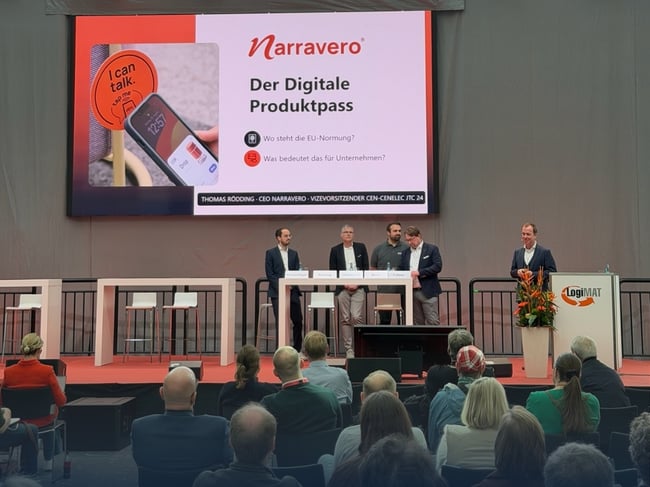
At the beginning of the session "The Digital Product Passport: A Pioneer for Circular Logistics" (LogiMat 2026 in Stuttgart, Germany), roughly half the audience raises their hands.
The question: who is familiar with the Digital Product Passport?
By the next question, only two – perhaps three – hands remain.
Who is looking forward to it?
The moment is brief, but telling. It captures where the industry stands today. The DPP has arrived but it is not yet part of everyday practice.
A stage that revealed more than opinions
That moment also sets the context for what follows on stage.
Alongside Thomas are two companies that engaged with the Digital Product Passport early and now work with it as a matter of course: Saredin Seine (CEO, SEINE Batteriesysteme) and Dirk Uhlenbrock (CEO B&W Cases of Success).
This is not a pairing for the occasion; it reflects relationships and experience built over time.
Beyond compliance: the DPP as infrastructure
In Thomas’s framing, the perspective shifts – almost imperceptibly.
The discussion moves beyond a narrow ESG lens and beyond the question of what, exactly, needs to be complied with. Instead, attention turns to something more fundamental: the structure underlying product information.
The Digital Product Passport emerges here as an infrastructure – one in which product data is aggregated, continuously updated, and remains accessible across the entire lifecycle.
That shift matters. The focus moves away from individual requirements and toward how product-related information is organised and made usable.
What this looks like in practice: SEINE Batteriesysteme
At SEINE Batteriesysteme, this approach is already tangible.
Each battery system is assigned a digital identity that accumulates information over time. Quality data, usage patterns, and condition are not stored in isolation but directly linked to the product itself.
The implications become clear in service operations. When a product is returned, there is no need to reconstruct its history. The relevant information is already there.
Interventions can be prepared more effectively, technicians arrive with the right spare parts, and the process becomes more predictable—for everyone involved.
A different angle: B&W Cases of Success
At B&W Cases of Success, the emphasis is slightly different.
The priority is to make information available at the point of use. Certificates, manuals, and product data are directly linked to the product and can be accessed immediately.
The need to search across multiple systems or documents largely disappears.
Twenty-seven pages of manual no longer make sense today.
Dirk Uhlenbrock, CEO, B&W Cases of Success
A practical example: a freight operator can verify on the spot whether a case meets the required certification – without additional steps. The information is simply there when it is needed.
What this panel reveals about the market
The individual examples matter less than the overall picture.
While many companies are still trying to understand what is coming, others have already begun to integrate the DPP into their operations. These two perspectives currently coexist.
They lead to very different conversations. On one side, the focus remains on requirements; on the other, it has already shifted to applications and processes.
Infrastructure as the real challenge
One point became clear: while data remains a central issue—especially in complex supply chains, where assembling the necessary information is far from trivial—the real challenge lies elsewhere.
The most important thing is to build a solid infrastructure.
Saredin Seine, CEO, Batteriesysteme
That does not mean a perfect system from the outset, but a foundation that can evolve over time.
Once that structure is in place, companies can focus on the real task: bringing data together and making it usable – without constantly having to rework the underlying system.
From compliance exercise to operational reality
The Digital Product Passport is still often seen as a future requirement.
At LogiMAT, however, it became clear that for some companies it is already part of day-to-day operations.
Once understood as infrastructure, it changes how products are managed—across maintenance, service, and long-term use.
/Comms%20Blog/Vom%20Produkt%20zur%20Information.jpg)