

EU DPP REGISTRY · 2026 UPDATE
The DPP Registry is live. And makes Digital Product Passports verifiable for the first time.
Since 20 July 2026, the central EU DPP Registry has been live, with a test environment and a user guide. What matters most: for the first time you can check whether a Digital Product Passport is registered and who is legally responsible for it. For most industries the DPP obligation itself only starts later, depending on the delegated act. But the direction is set.
No obligation, free of charge.
What is the EU DPP Registry?
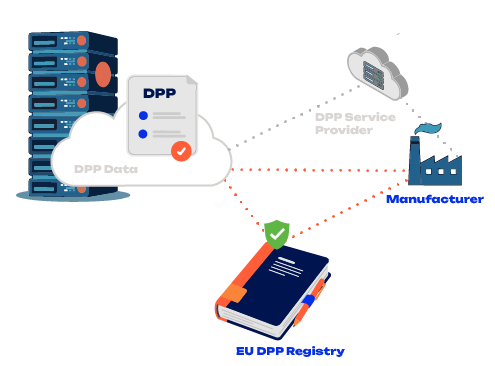
The EU DPP Registry is the central, official directory for Digital Product Passports. Think of it as an address book: it does not store the Digital Product Passport itself, but the register entry for it. This entry holds the address where the Digital Product Passport can be found, and the verified economic operator, meaning the responsible party behind the Digital Product Passport.
The actual content stays with the producer or their DPP service provider, and so does the responsibility for correct, verifiable data. Through the Registry, authorised bodies such as customs and market surveillance can determine whether a product has a registered Digital Product Passport. It has been live since 20 July 2026, including a test environment and a user guide.
Why the Registry is a milestone: reliable and accountable
More important than mere findability is the accountability it creates. The Registry establishes verifiable product responsibility: a registered Digital Product Passport is clearly assigned to a verified economic operator. Until now, a responsible party stated in a customs declaration was hard to verify. Now it is clearly identifiable and reliably attributable.
For the first time, it is securely and demonstrably verifiable whether a product has a registered Digital Product Passport and which verified economic operator is responsible for it.
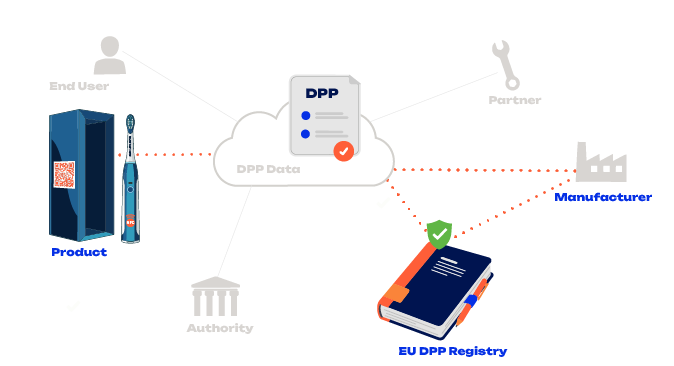
20 July: a new product logic
Two interactive chapters to click through: switch between today's and tomorrow's market logic and discover what the Registry stores, and what it does not.
What changes
Fragmented product data becomes verifiable infrastructure.
The shift moves away from scattered data silos and after-the-fact gathering, towards prepared data infrastructure with targeted access. Switch and see the difference.
Until now, the Digital Product Passport only came into being, if at all, after the sale: place the product on the market, supply data later, control after the fact. Errors only surface once the product is long on the market.
A common misunderstanding
The Registry is the address book, not the filing cabinet.
The Registry does not store the Digital Product Passport, but the verified entry that leads to it. The data, and the responsibility for it, stay with you.
Which clock you should be watching
In perspective, the DPP affects many physical products on the EU market and arrives step by step, product group by product group. The Battery Passport goes first: for certain batteries the Digital Product Passport applies from 18 February 2027. Further groups such as textiles, furniture, tyres, aluminium or electronics follow through their own delegated acts. The delegated act for textiles is currently expected for 2027; the obligation to apply it is likely to follow around 18 months later.
For most companies this means: the obligation does not apply immediately, but only with the delegated act for your product group. Even so, time is tighter than it looks. Because whatever is meant to be on the shelves when the obligation starts is sourced, developed and produced long before. The usual lead times pull the real starting point noticeably forward.

Key point: the DPP probably does not apply to you from tomorrow, but the lead time is shorter than you think. Whoever builds the data foundation now is ready in time, instead of scrambling to catch up later.
What you can do now: implement it yourself or with a partner
Whether you implement it yourself or use a DPP service provider is a make-or-buy decision. One thing stays with you in every case: organising your data, because that is what takes the longest. So the rule is: start early, even before every detail of the delegated act is settled. Three areas decide how well the start goes:
1. Clarify responsibility & roles
Who is the responsible economic operator? Who may register, which access rights apply per role, and how are service providers cleanly integrated?
2. Structure the data foundation & sources
Which product data is needed, who is responsible for it, which systems does it come from, and at what level of granularity is it available?
3. Secure implementation & operation
How are the DPP, the Registry connection, versioning and audit trail implemented technically: in-house or with a DPP service provider?
Unsure where your company stands in the Registry process?
Book a 30-minute consultationWhere this leads: three levels
Looking two or three years ahead, the Registry unfolds its impact on three levels.
More efficient dealings with authorities
The Registry and the DPP become shared infrastructure between companies and authorities. Machine-readable formal data enables automation, and companies speak the same language with different authorities instead of constantly adapting their processes. In effect, less bureaucracy at lower cost.
A reliable data source
For the first time, a reliable source of information emerges across the entire value chain up to the consumer. A central product register of this kind has not existed anywhere before, a distinctly European feature: product information with a guarantee rather than without.
Agentic commerce & AI
Reliable, machine-readable product data with clear responsibility is the basis for AI that reads, compares and advises on products. Against deepfakes and AI-generated claims in particular, a demonstrably registered Digital Product Passport becomes a mark of quality, even where there is no obligation.
200+
Enterprise customers rely on Narravero
300M
Platform interactions per month
12
Industries covered, from fashion to batteries
81%
of companies have no DPP plan yet, according to KPMG (Feb 2026)
WHY NARRAVERO
Narravero is the platform for the Digital Product Passport. It translates regulatory requirements into strategic competitive advantages: more than 200 enterprise customers across 12 industries use it, with 300 million DPP interactions per month, hosted in the EU, fully GDPR compliant. Narravero is a GS1 Solution Partner and was recognised with the Global DPP Excellence Award in 2025. CEO Thomas Rödding is actively involved in shaping the DPP standards as Co-Chair of the European standards body CEN-CENELEC JTC 24, in a personal capacity. Our conviction: the Digital Product Passport is not a compliance task but a channel of its own to the customer, for product story, services and first-party data.
Frequently asked questions about the DPP Registry
Do I have to wait for the delegated act to get started?
No. The technical foundation of the DPP is the same across product groups: a unique identifier, a machine-readable data carrier, audit-proof records and a standardised connection. Investing in this foundation today builds nothing that becomes outdated later. The relevant delegated act only adds which content exactly belongs in the Digital Product Passport.
Does registration make me compliant automatically?
No. Registration does not create compliance. At best you achieve a cost-efficient presumption of conformity: once the law and the matching technical standards are published together in the EU Official Journal and you work to them, the presumption of conformity applies, faster and cheaper than a separate conformity assessment procedure.
Who is responsible for the content of the Digital Product Passport?
The economic operator, for example the producer, the entity placing the product on the market, the brand or the importer. They are responsible for keeping the content correct, up to date and audit-proof. The EU does not check the content in advance, but can access it through customs and market surveillance and demand accountability.
Is your DPP strategy registry-ready?
In a free 30-minute consultation we work out together where your company stands in the Registry process and which next steps make sense for you.
Book a 30-minute consultationNo obligation, free of charge.