

 ·
17 minute read
·
17 minute read
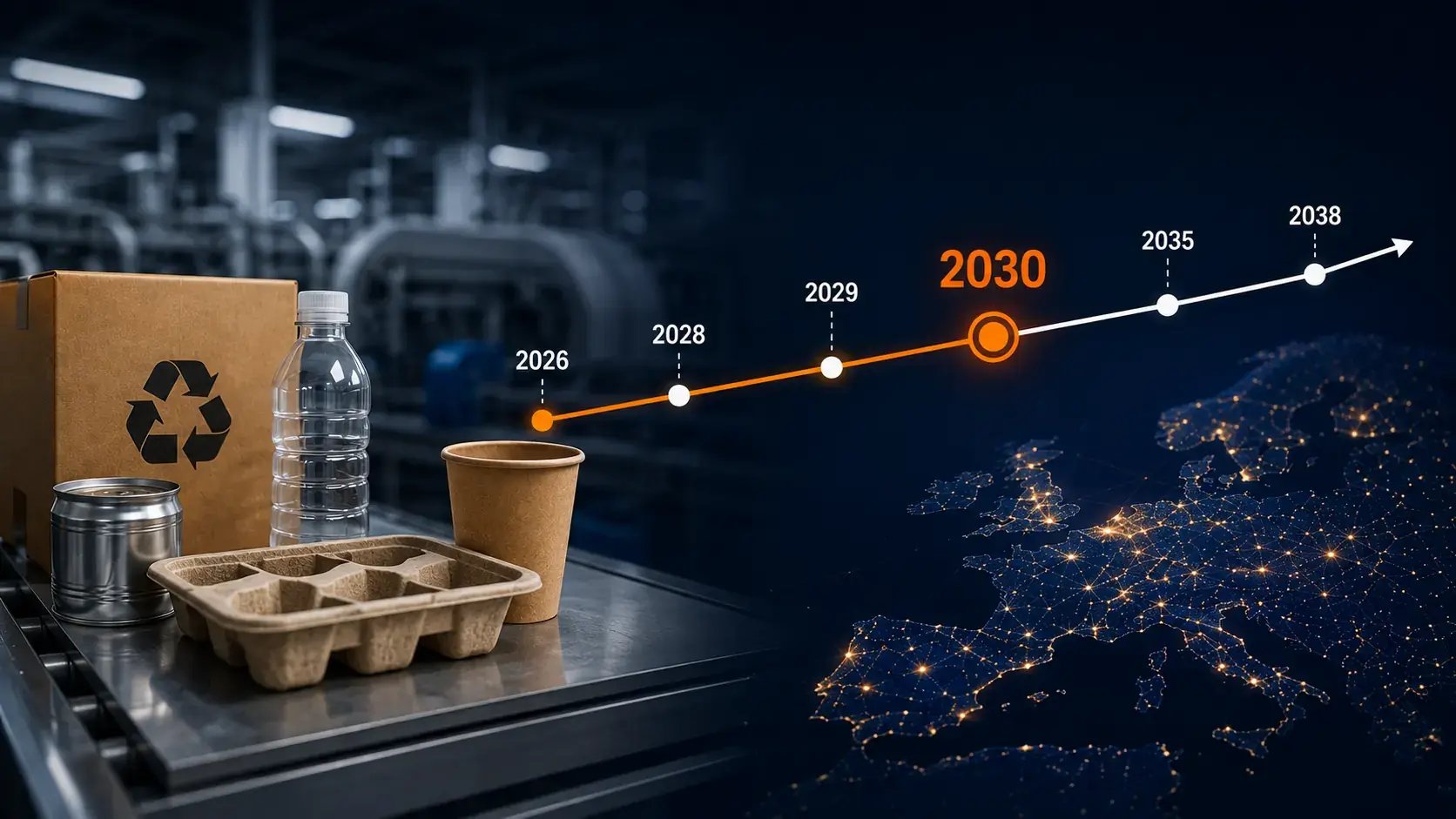
The PPWR timeline is set out wrongly in most overviews, and the error is systematic. It appears as a row of calendar dates: , 2028, 2030, 2038. In the PPWR, Regulation (EU) 2025/40 on packaging and packaging waste, several of the central obligations carry no single date at all. They carry a formula: this date, or a period from the entry into force of an act, whichever is later.
That is not a legal nicety. It is the difference between a date you can plan a project against and a date you have to watch. This timeline sorts both kinds, names the legal basis, and says at each stage what it means in practice for a manufacturing business.
Why the PPWR has two kinds of deadline
The EU Packaging and Packaging Waste Regulation (PPWR) entered into force on and has applied directly in all Member States since 12 August 2026. It did not have to be transposed into national law. What actually bites on the date of application is still only part of the regulation.
Three terms make the difference between the deadlines legible. A fixed deadline names a calendar date with no further condition, such as 12 February 2028 for the compostability requirements. A dynamic deadline names a calendar date and, on top of it, a period running from the entry into force of an act, with the later of the two applying. And an implementing act is the downstream Commission act that fills a requirement in technically, setting out how a label looks or how recycled content is calculated. Delegated acts work the same way in timing terms, but may supplement the regulation itself within narrow limits.
In practice that means this: with a dynamic deadline, the date given is the earliest possible one, not the likely one. Plan your roadmap on the calendar dates alone and you either commit budget too early, or you assume a delay that never comes. Both are avoidable if you read what each date hangs on.
Key point: With dynamic PPWR deadlines the later of the calendar date and the act entering into force applies. The date on its own carries no planning.
The PPWR timeline from 2026 to 2038 at a glance
The overview lists the dates on which an obligation bites for manufacturers of physical products and their packaging suppliers. It leaves out obligations aimed solely at Member States, hospitality or bricks-and-mortar retail. The deadlines that apply to the Commission itself sit in their own section further down, because they decide the dynamic dates in this table.
| Date | What applies | Basis and status |
|---|---|---|
| 26 May 2026 | Pallet wraps and strapping bands are exempted from the hundred per cent reuse targets | Delegated Decision (EU) 2026/429 on Article 29(2) and (3)
in force |
| 12 August 2026 | Date of application: conformity assessment, technical documentation, EU declaration of conformity, packaging identification, substance restrictions, supplier information duty, extended producer responsibility | Articles 5, 15, 16, 38, 39, 44, 45, Annexes VII and VIII
fixed deadline |
| 12 February 2028 | Compostability requirements for the packaging types covered, such as tea bags, coffee capsules, sticky labels on fruit and vegetables and very lightweight plastic carrier bags | Article 9
fixed deadline |
| 12 August 2028 | Harmonised labelling of material composition on the packaging | Article 12, or 24 months after the implementing acts enter into force
dynamic, act outstanding |
| 1 January 2029 | Deposit and return systems for single-use plastic beverage bottles up to three litres and for metal beverage containers, target 90% separate collection | Article 50
fixed deadline |
| 12 February 2029 | Labelling of reusable packaging and provision of further information through a QR code or another open digital data carrier | Article 12(2), or 30 months after the act under Article 12(6) enters into force
dynamic, act outstanding |
| 1 January 2030 | Recyclability at performance grade C or better, minimum recycled content in plastic packaging, minimisation of weight and volume, empty space ratio of no more than 50%, bans on certain formats under Annex V, first stage of the reuse targets | Articles 6, 7, 10, 24, 25, 29
Articles 6, 7 and 24 dynamic |
| 2032, provisional | Packaging containing substances of concern has to be marked using standardised, open digital marking technologies | Article 12(1), 24 months after the act under Article 12(7), second subparagraph, enters into force
dynamic, act outstanding, date calculated |
| 1 January 2035 | Recyclability is additionally assessed against whether the material is recycled at scale | Article 6, or five years after the acts under Article 6(5) enter into force
dynamic, act outstanding |
| 1 January 2038 | Packaging must reach at least performance grade B, meaning it is at least 80% designed for recycling | Article 6
fixed deadline |
The binding wording is in Regulation (EU) 2025/40 on EUR-Lex. The European Commission has also published a guidance document on the PPWR and keeps an overview of the packaging waste rules.
Key point: Four dates in this table are fixed. Five hang wholly or partly on acts that have not been published yet.
Since 12 August 2026: the evidence obligations are live
The first stage of the timeline is the uncomfortable one, because it leaves no preparation time. Since the date of application, every packaging type needs a conformity assessment under Article 38, technical documentation under Annex VII and an EU declaration of conformity under Article 39 and Annex VIII. On top of that come unique identification of the packaging, the substance restrictions under Article 5 including the limits for heavy metals and for PFAS in food contact packaging, and the ban under Article 12(8) on labels, marks and symbols that are liable to mislead about the sustainability of the packaging.
Who carries that duty is not always obvious, and the English wording of the regulation makes it easier to get wrong. The manufacturer is the role that answers for conformity, and it follows the brand rather than the factory: whoever has packaging developed or produced under their own name or trade mark is the manufacturer, even when a contract packer makes it. The producer is a different role and belongs to extended producer responsibility, meaning registration, volume reporting and the financing of waste management in each Member State. If you have not mapped that cleanly for your business yet, the companion article on who is affected by the PPWR works through it.
One detail of this stage governs the effort of every later one. Article 15(10) requires you to provide the necessary information, including the technical documentation, electronically on a reasoned request from an authority, as a rule within ten days. What we see with customers: it is not the knowledge that fails at that deadline, it is the filing. The data exists, but spread across purchasing, quality assurance, development and three supplier mailboxes.
Key point: The evidence obligations already apply in full, while the requirements you have to evidence are still growing.
2028 and 2029: labelling, compostability, deposits
12 February 2028: compostability
Article 9 requires a narrowly defined set of packaging to be industrially compostable. It covers tea bags, coffee pods and capsules, sticky labels on fruit and vegetables and very lightweight plastic carrier bags, among others. For a printed folding carton or a furniture pack the provision is usually not relevant. You still have to check it, because individual items in a range can fall inside.
12 August 2028: harmonised labelling
From this date the packaging has to state its material composition in a harmonised form. There are two conditions in the same sentence, though: the date is 12 August 2028 or 24 months after the relevant implementing acts enter into force, whichever is later. Those acts are what define how the label looks at all, and their own deadline already expired on 12 August 2026. They have not appeared. As long as only the Joint Research Centre proposal from January 2026 is on the table, 12 August 2028 is not a changeover date for print data, it is a floor.
Article 12(4) does not add a second mandatory label to this date. It applies only if you state a recycled content or biobased content share on the packaging: that statement then has to follow the format the same implementing acts prescribe and be calculated using the methodology under Article 7(8).
1 January 2029: deposit and return systems
Member States have to operate deposit and return systems for single-use plastic beverage bottles up to three litres and for metal beverage containers, targeting 90% separate collection. Outside the beverage segment the date matters mainly as a signal.
12 February 2029: labelling of reusable packaging
Article 12(2) requires reusable packaging to carry a label about its reusability, plus further information through a QR code or another standardised and open digital data carrier. This date is dynamic too: it applies to packaging placed on the market from 12 February 2029, or from 30 months after the implementing act under Article 12(6) enters into force, whichever is later. While that act is missing, neither the scope of the information nor the format of the data carrier is settled. For open loop systems without a system operator as set out in Annex VI, Article 12(3) means the obligation does not apply at all.
Key point: Both labelling dates, 2028 and 2029, hang on acts that have yet to define what the label contains.
2030: the bottleneck for material and design
1 January 2030 is the date that matters most in this timeline, because six requirements converge there and all six bear on packaging design. It is the earliest common target date, though, not a guaranteed one: three of the six hang on acts that are still missing, and move with them.
- Recyclability (Article 6): packaging has to meet the design for recycling criteria and reach at least performance grade C, meaning at least 70% recyclable. The date is 1 January 2030 or 24 months after the delegated acts enter into force, whichever is later.
- Minimum recycled content (Article 7): 30% for contact sensitive PET packaging, 10% for contact sensitive packaging made of other plastics, 30% for single-use plastic beverage bottles and 35% for other plastic packaging. This is a dynamic deadline as well, tied to three years after the implementing act under Article 7(8) enters into force.
- Minimisation of weight and volume (Article 10): packaging may not be larger or heavier than its function requires, and the trade-off against the criteria in Annex IV has to be documented. Article 10(1) names 1 January 2030 with no link to an act, so this date holds.
- Empty space ratio (Article 24): no more than 50% empty space in grouped, transport and e-commerce packaging. Under Article 24(1) the duty sits with the economic operator that fills or uses this packaging, not with every packaging producer. Dynamic as well: 1 January 2030 or three years after the relevant implementing acts enter into force, whichever is later. The Commission has to set the calculation method by 12 February 2028.
- Format bans (Article 25 and Annex V): certain single-use packaging may no longer be placed on the market for certain uses.
- Reuse targets (Article 29): the first stage of the quotas, with the exemption for pallet wraps and strapping bands agreed in 2026.
For planning, the combination is what counts, not the individual requirement. A laminate that achieves recyclability can miss the recycled content target. Packaging trimmed to minimum weight can breach the empty space ratio, because logistics configures it differently. These conflicts can only be resolved if material data, weights and evidence sit in one dataset per packaging version rather than in five spreadsheets.
That three of the six can move is not, by the way, an argument for waiting. Plan on it and you are planning on a decision that is taken in Brussels rather than by you. Our own read on this is uncomfortable: defer the material decision to 2029 and you are no longer deciding on packaging design. Requalification, tooling, supplier qualification and selling through existing stock easily take two years together.
Key point: Six design requirements converge in 2030 and can contradict each other. Three move with their acts, three do not.
2032: digital marking for substances of concern
One obligation in this timeline carries no calendar date at all, only a formula. Article 12(1) requires packaging that contains substances of concern within the meaning of Article 5 to be marked using standardised, open digital marking technologies. The obligation bites 24 months after the implementing act under Article 12(7), second subparagraph, enters into force. That act is what defines how those substances are identified, and the Commission has until to adopt it. As of September 2026 work on it had not started.
2032 is therefore the earliest conceivable date, and it is calculated rather than written in the regulation. It belongs in the timeline anyway, because it is a manufacturer obligation and because it is the point where packaging data and product data meet most directly. Whoever already holds substance data per packaging version for the Article 5 restrictions has the input for this marking obligation. Whoever does not will collect the same data twice.
Key point: The digital marking of substances of concern has no date in the regulation. It follows 24 months after an act that has not been started.
2035 and 2038: recyclability tightened twice
Article 6 works with two criteria that bite at different times. From 1 January 2030 what counts is design for recycling. From the question is added whether the material is actually recycled at scale, meaning whether a functioning collection and recovery infrastructure exists for that packaging category at all. That second test is only partly in your hands, because it depends on how the market develops. This date is dynamic too: it applies from 1 January 2035, or five years after the implementing acts under Article 6(5) enter into force, whichever is later. Those acts set the assessment method in the first place and are due by 1 January 2030.
From the threshold rises: only packaging that reaches at least performance grade B is permitted, meaning at least 80% designed for recycling. The recycled at scale test does not fall away, it continues to apply from 2035. In 2038 both criteria therefore have to be met together. Whatever meets grade C today drops out of the market.
The timeline does not end there. On 1 January 2040 the recycled content targets rise to up to 65%, and the reuse targets reach their second stage. As a planning horizon 2038 is still the sensible end point, because that is where the last tightening of the material requirement sits.
Key point: Reach only the minimum grade C in 2030 and you have the same problem again in 2038, then at 80%.
The acts that are still missing
Commission acts are still missing in seven areas. Six of them decide whether the dynamic dates in this timeline hold, the seventh only specifies the requirements for reusable packaging. Article 12 alone accounts for at least three implementing acts with two different deadlines, which is why it appears twice in the table. They belong in every roadmap even though they are not company obligations. EUROPEN keeps a tracker of the PPWR secondary legislation with the status of each act.
| Commission deadline | Which act | Moves |
|---|---|---|
| by 12 August 2026 | Implementing acts on labelling under Article 12: the label format under paragraph 6, the data carrier for reusable packaging and the methodology for identifying material composition under paragraph 7 | 12 August 2028 and 12 February 2029 |
| by 31 December 2026 | Calculation and verification of recycled content under Article 7(8) | 1 January 2030 |
| by 12 February 2027 | Minimum number of rotations for reusable packaging under Article 11(2) | no headline date, it specifies the requirements for reusable packaging |
| by 1 January 2028 | Design for recycling criteria and the performance grades under Article 6 | 1 January 2030, and the assessment basis for 1 January 2038 |
| by 12 February 2028 | Method for calculating the empty space ratio under Article 24(2) | 1 January 2030 |
| by 1 January 2030 | Methodology for assessing whether a packaging category is recycled at scale, under Article 6(5) | 1 January 2035 |
| by 1 January 2030 | Methodology for identifying substances of concern through standardised, open digital marking technologies, under Article 12(7), second subparagraph | the digital marking obligation, 2032 at the earliest |
The first of these deadlines has already passed without an act. How realistic a delay is for the others is shown by an act that does not appear in this table, because it moves none of the timeline dates: the single format for registration and reporting in the register of producers under Article 44.
The deadline expired on . The draft only went out for consultation in August 2026, roughly six months late.
AGRINFO on the consultation about EU national registers of producers. Feedback ran until , with adoption expected in the fourth quarter of 2026 and 18 months for Member States after that.
Six months late on an act that only sets a reporting format is a realistic yardstick for the substantially harder acts on recyclability, recycled content and empty space. For you that does not mean everything moves back. It means you have to know the status of each act instead of planning against a calendar date.
That the regulation itself keeps moving after entry into force is shown by the first amending act. Delegated Decision (EU) 2026/429 has applied since . It exempts pallet wraps and strapping bands from the hundred per cent reuse targets in Article 29(2) and (3), without touching the general target in paragraph 1.
Key point: Outstanding acts in six areas decide the 2028, 2029, 2030, 2032 and 2035 dates. The labelling deadline has already passed.
What to prepare, and when
The order matters more than the speed. Five steps that fit into half a year.
- Map your packaging portfolio against the deadlines. Create one row per packaging type and version and mark which deadlines in this timeline apply at all. Plastic content, food contact, reuse design and Annex V formats decide which dates are relevant for you.
- Close the evidence gap for 2026. For each packaging type, check whether the conformity assessment, the technical documentation and the EU declaration of conformity exist and are current. These obligations already apply, independently of every later stage.
- Align material and design decisions with 2030. Packaging you develop today will still be running in 2030. Work out with development and purchasing which material combinations reach performance grade C and where recycled content is available.
- Set up an acts radar with a named owner. Name one person who tracks the outstanding delegated and implementing acts and updates the date for each affected packaging item. Without that role the dynamic deadlines go unwatched.
- Keep packaging data under version control. Hold structure, weights, evidence and changes for each packaging version in one dataset instead of scattered documents. Every further stage of the timeline calls for evidence on exactly that data basis.
Key point: Map the portfolio against the deadlines first, then close the evidence gap, then decide on material. Other orders create rework.
The PPWR timeline in numbers
12 Aug 2026
Date of application of Regulation (EU) 2025/40 in all Member States (EUR-Lex)
10 days
Deadline for providing the documentation electronically on a reasoned request from an authority (Article 15(10))
70% / 80%
Recyclability thresholds from 2030 (grade C) and from 2038 (grade B) (Article 6)
35%
Minimum recycled content for other plastic packaging in the first stage (Article 7(1))
31 Dec 2026
Commission deadline for the acts on calculating recycled content (Article 7(8))
6 months
Delay on the register of producers act under Article 44, draft out only in August 2026 (AGRINFO)
Key point: A ten day response deadline against requirements that step up three times by 2038 calls for a versioned data basis.
Structuring packaging data with Narravero
Narravero runs an end-to-end DPP platform. More than 200 corporate customers across twelve industries use it, it handles 300 million platform accesses per month, EU-hosted and GDPR-compliant.
For this timeline one point is the practically relevant one: every stage from 2028 onwards calls for evidence about the same packaging, only with a growing scope. Structure, components, individual weights, substance evidence, test reports, method, approval and change history sit in one versioned dataset per packaging type and version instead of in scattered filing. Data from ERP, PIM and supplier systems is brought together through open interfaces, every change creates a traceable entry, and permissions control who sees which evidence.
Beyond the PPWR, Article 12(5) is worth a look. As soon as Union law requires a data carrier for the packaged product, product and packaging information have to run through a single shared data carrier. For companies with products under the Ecodesign Regulation, the packaging data question therefore lands together with building the Digital Product Passport.
What the platform does not replace: the technical assessment, the legal determination of your role, and your responsibility as the manufacturer.
Frequently asked questions about the PPWR timeline
When did the PPWR start to apply?
Regulation (EU) 2025/40 entered into force on 11 February 2025 and has applied directly in all Member States since 12 August 2026. The date of application does not mean that every requirement bites on that day. A substantial part of the obligations only starts in 2028, 2029, 2030 or later.
Which PPWR deadlines are already fixed?
Fixed are the date of application on 12 August 2026, the compostability requirements for the packaging types covered from 12 February 2028, the deposit and return systems from 1 January 2029, and the rise to performance grade B on 1 January 2038. Dynamic are the harmonised labelling in 2028, the labelling of reusable packaging in 2029, the requirements under Articles 6, 7 and 24 within the 1 January 2030 date, the digital marking of substances of concern from 2032 at the earliest, and the recycled at scale test on 1 January 2035.
What is a dynamic deadline under the PPWR?
A dynamic deadline names a calendar date and, on top of that, a period running from the entry into force of a delegated or implementing act. The later of the two applies. If the act slips in Brussels, the obligation moves back with it. The calendar date is therefore the earliest possible date, not the final one.
What has applied since 12 August 2026?
Since 12 August 2026 you need a conformity assessment under Article 38, technical documentation under Annex VII, an EU declaration of conformity under Article 39 and Annex VIII, and unique identification of the packaging. The substance restrictions under Article 5 also apply, including the limits for heavy metals and for PFAS in food contact packaging, along with the supplier information duty under Article 16 and the obligations arising from extended producer responsibility.
When does packaging have to be recyclable?
From 1 January 2030 packaging may only be placed on the market if it meets the design for recycling criteria and reaches at least performance grade C, meaning it is at least 70% recyclable. From 1 January 2035 the assessment adds whether the material is actually recycled at scale, or five years after the implementing acts under Article 6(5) enter into force, whichever is later. From 1 January 2038 at least performance grade B with 80% is required on top, and the recycled at scale test continues to apply alongside it.
When do the minimum recycled content targets for plastic packaging apply?
The first stage applies from 1 January 2030 or three years after the implementing act under Article 7(8) enters into force, whichever is later. The targets are 30% for contact sensitive PET packaging, 10% for contact sensitive packaging made of other plastics, 30% for single-use plastic beverage bottles and 35% for other plastic packaging. From 2040 the targets rise to 50%, 25%, 65% and 65%.
When does the 50% empty space ratio apply?
Article 24 limits empty space in grouped, transport and e-commerce packaging to 50%. The date is 1 January 2030 or three years after the relevant implementing acts enter into force, whichever is later. The Commission has to set the method for calculating empty space by 12 February 2028. Until then it is not settled how the value is determined for a given packaging item.
When does the harmonised labelling of material composition arrive?
Article 12 names 12 August 2028 or 24 months after the relevant implementing acts enter into force, whichever is later. Those acts are what define how the label actually looks. As long as they have not been published in the Official Journal, 12 August 2028 cannot be treated as a binding changeover date for print data and packaging artwork.
When does reusable packaging need a QR code?
Article 12(2) attaches the obligation to reusable packaging placed on the market from 12 February 2029, or from 30 months after the implementing act under Article 12(6) enters into force, whichever is later. The data carrier has to be a QR code or another standardised and open digital data carrier. Under Article 12(3) the obligation does not apply to open loop systems without a system operator as set out in Annex VI.
When does packaging containing substances of concern need digital marking?
Article 12(1) requires packaging that contains substances of concern within the meaning of Article 5 to be marked using standardised, open digital marking technologies. The regulation names no calendar date for it. The obligation applies 24 months after the implementing act under Article 12(7), second subparagraph, enters into force, and the Commission has until 1 January 2030 to adopt that act. On that basis 2032 is the earliest possible date, and it is provisional.
Which acts are still missing and by when does the Commission have to adopt them?
Acts are still missing in seven areas, six of which move dates in this timeline: the labelling acts under Article 12, meaning the label format under Article 12(6) and the methodology for identifying material composition under Article 12(7), both due by 12 August 2026; the acts on calculating recycled content under Article 7(8) by 31 December 2026; the minimum number of rotations for reusable packaging under Article 11(2) by 12 February 2027; the design for recycling criteria and performance grades under Article 6(4) by 1 January 2028; the method for calculating the empty space ratio under Article 24(2) by 12 February 2028; the methodology for the recycled at scale assessment under Article 6(5) by 1 January 2030; and the methodology for identifying substances of concern under Article 12(7), second subparagraph, also by 1 January 2030. The labelling deadline has already passed. As long as an act is missing, the date attached to it is only the earliest possible one.
Has anything about the PPWR already changed since it entered into force?
Yes. Delegated Decision (EU) 2026/429 of 25 February 2026 has applied since 26 May 2026. It exempts pallet wraps and strapping bands used to stabilise products from the hundred per cent reuse targets in Article 29(2) and (3). The general reuse target in Article 29(1) is not affected.
What happens after 2038?
The timeline does not end in 2038. On 1 January 2040 the minimum recycled content targets for plastic packaging rise to up to 65%, and the reuse targets under Article 29 reach their second stage. For planning purposes 2038 is still the sensible horizon, because that is when the final tightening of recyclability takes effect and the material decision is locked in.
Is it enough to look at the 2030 requirements in 2029?
As a rule, no. Packaging developed today is typically still on the market in 2030, and changing materials in laminates, coatings or adhesives pulls requalification, tooling changes and supplier changes behind it. Anyone who defers the decision to 2029 is no longer deciding on packaging design, only on an exemption request.