
 ·
12 minute read
·
12 minute read
Who is affected by the PPWR? In short: almost every company that places packaged products on the EU single market, imports them or resells them. Regulation (EU) 2025/40 on packaging and packaging waste (PPWR) has applied directly in every Member State since . It attaches obligations to a role, not to your industry, and you do not get to choose that role yourself.
This is where the most common misunderstanding sits. Many companies assume they are outside the scope because they do not produce packaging themselves. The PPWR sees it differently. Whoever has packaging designed or manufactured under its own name or trade mark is the manufacturer in the legal sense and carries the product compliance responsibility, even when the box is made in someone else's plant.
One warning before the detail: the English wording of the regulation is counter-intuitive. Manufacturer and producer are two different roles with two different sets of obligations, and neither of them depends on who runs the machine.
Who is affected by the PPWR? The short answer
The PPWR covers all packaging, regardless of material and regardless of whether it is supplied empty or as part of packaged products. Sales packaging, grouped packaging, transport packaging, e-commerce packaging, service packaging: all of it falls within the scope.
That makes the scope question less of a yes or no question and more of an allocation question. Not: am I in? But: in which role am I in, for which packaging, and in which Member State?
Four groups are affected in practice almost without exception: brand owners selling packaged products, companies that physically produce packaging for their customers, retailers with private labels or direct imports, and companies that bring goods into the EU from third countries. If you sell services only and never ship a physical product, you stay outside. In industrial mid-market companies that is the exception.
Key point: The PPWR does not ask about your industry. It asks about your role per packaging, product and market.
The PPWR roles and what they mean
The regulation defines the economic operators in Article 3. Four terms decide in practice which obligations land on your desk.
The manufacturer is the company that manufactures packaging or a packaged product itself, or has it designed or manufactured under its own name or trade mark (Article 3(1)(13) PPWR). This role owns the product compliance side: conformity assessment, technical documentation, the EU declaration of conformity, the identification mark and control over changes.
The producer is a different role with a different effect (Article 3(1)(15) PPWR). It covers whoever, as manufacturer, importer or distributor, first makes packaging available in the Member State where it becomes waste. This role decides registration, volume reporting and the financing of waste management, and it has to be determined separately for every country you sell in.
The supplier supplies packaging or packaging materials to the manufacturer (Article 3(1)(16) PPWR). Its central duty sits in Article 16: hand over all information and documentation the manufacturer needs to demonstrate conformity.
Importers and distributors close the chain. The importer places packaging or packaged products from third countries on the EU market. The distributor passes them on inside the EU and has to check, before offering the goods, that the required markings are in place and that the responsible producer is registered.
Key point: Manufacturer governs the conformity of the packaging, producer governs waste responsibility in each country. The two often sit with the same company, but not always.
Why manufacturer has nothing to do with who makes the box
The classic mistake in practice: a fashion company has shoeboxes produced by a carton plant to its own specification and with its own logo, and assumes the carton plant carries the PPWR obligations. It does not. The manufacturer is the fashion company, because the packaging is made under its own trade mark. The carton plant is the supplier.
One manufacturer per supply chain
For sales and grouped packaging the manufacturer is typically the filler, and as a rule also the brand owner. European Commission guidelines on the PPWR, C(2026) 3702 final of , Official Journal notice C/2026/3084
The European Commission guidelines on the PPWR support this reading. What matters is who carries out the final processing steps, so who fills and seals, and who holds the decision-making power over the design in the contractual relationship.
For other packaging types the picture flips. For transport, service and primary production packaging, the guidelines put the role with the company that produces this packaging, unless the customer marks it clearly with its own name or trade mark. If you buy plain cartons or service packaging and do not brand them, assess those items separately.
That is good news and bad news at once. Good, because the allocation is unambiguous and nobody has to document the same packaging twice. Bad, because the responsibility cannot be passed down the chain by contract. You can have data delivered to you, not the obligation.
Key point: For sales and grouped packaging, the manufacturer is whoever sets the brand. Contracts do not move that role.
What applies to retail, private labels and direct imports
For retail the PPWR shifts the picture more sharply than for brand owners. The German Central Agency Packaging Register, which administers the national packaging register, sets out how manufacturer and producer are distinguished: for private labels the ordering company is the manufacturer, not the contract packer, even where the packer is named on the packaging. An importer established in Germany that brings packaging from third countries to the German market acts as the producer.
The timing is the part that catches companies out. In its statement of April 2026 the agency made clear that no transition period is provided for: participation in a waste management scheme has to be in place before the packaged goods are distributed. Where it is missing, the practical consequence is a ban on distributing the products concerned.
For retailers with a mixed assortment that means private label and third-party brands have to be assessed separately. With a third-party brand your supplier is the manufacturer, with your private label you are. Same shelf, often the same goods receipt.
Key point: With private labels and direct imports the retailer becomes the responsible operator itself, with no grace period.
Roles and obligations by business model
The overview below shows the typical allocation in the standard case. It does not replace a case-by-case assessment, but it structures the discussion.
| Business model | Role in the standard case | Core obligations |
|---|---|---|
| Brand owner selling packaged products | manufacturer, and producer in its own market | Conformity assessment, technical documentation, EU declaration of conformity, registration and volume reporting per market |
| Company physically producing packaging to customer specification | supplier, and manufacturer for unbranded transport, service and primary production packaging | Hand over the information and documentation needed to demonstrate conformity (Article 16), report changes |
| Retailer with private labels | manufacturer and producer | Full manufacturer obligations for the private label packaging, plus registration and scheme participation |
| Retailer selling third-party brands | distributor | Due diligence: required markings present, producer registered |
| Importer from third countries | importer, often also producer | Verify the manufacturer's conformity and documentation, affix own contact details, meet producer responsibility in the target market |
| Provider of reusable packaging | economic operator under Article 26 | Ensure a reuse system and describe its compliance in the technical documentation |
| Online seller shipping to other EU countries | assess per target market, often producer there | Registration in the target market, authorised representative where required, volume reporting |
What we see with customers again and again: the single role is not the problem, the combination is. A furniture company with its own production, traded goods, direct imports from Asia and end-customer shipping into six EU countries holds four roles in parallel, and each one pulls a different set of evidence behind it.
Key point: One company can be manufacturer, producer, importer and distributor at the same time, each for different products and markets.
Special cases that shift the role allocation
Five constellations change the picture and belong in every scope assessment.
- Micro-enterprises. If the ordering company is a micro-enterprise in the sense of the EU definition (fewer than ten employees and an annual turnover or balance sheet total of at most two million euros) and the supplier is established in the same Member State, the supplier can become the manufacturer (Article 3(1)(13)(b)).
- Plain standard packaging. If you buy unprinted cartons off the shelf and use them without any design input of your own, check who actually set the design specification.
- Repacking and altering. Anyone who alters packaging that has already been placed on the market in a way that may affect its conformity can move into the manufacturer role. That also touches co-packers and fulfilment setups.
- Establishment outside the EU. Without an establishment in the target Member State you will normally need an authorised representative for extended producer responsibility.
- Reusable packaging. Whoever first makes reusable packaging available in a Member State has to ensure a reuse system there and document its compliance (Article 26). The additional digital labelling duty for reusable packaging applies later and depends on an implementing act.
Key point: Micro-enterprises, plain packaging, repacking, third-country establishment and reuse can all overturn the obvious role allocation.
In scope does not mean everything applies today
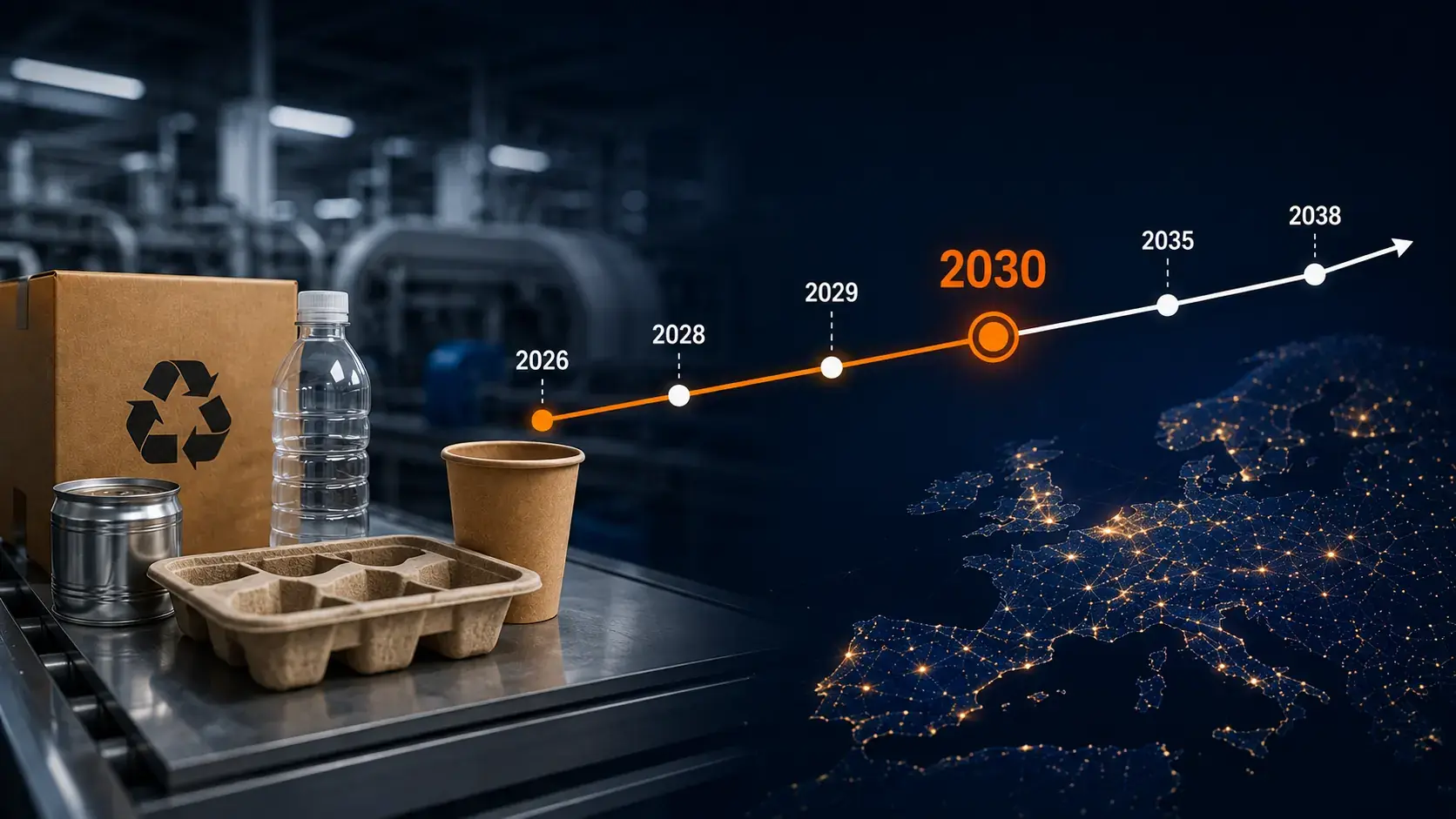
Scope and the extent of your obligations get mixed up easily. The regulation has applied since 12 August 2026, and with it the organisational duties: determine roles, assess conformity, keep documentation, secure registration and scheme participation. Some of the substantive requirements already apply too, above all the substance restrictions under Article 5 with the limits for heavy metals and for PFAS in food contact packaging. The requirements for design, labelling, recyclability and recycled content follow in stages.
| Requirement | Legal basis | Application |
|---|---|---|
| Conformity assessment, technical documentation, EU declaration of conformity | Articles 15, 38, 39 | since 12 August 2026 |
| Substance restrictions, including heavy metals and PFAS in food contact packaging | Article 5 | since 12 August 2026 |
| Registration and volume reporting per Member State | Articles 44, 45 | since 12 August 2026, continued nationally through the respective register |
| Harmonised material labelling | Article 12 | from 12 August 2028 or 24 months after the implementing acts enter into force, whichever is later |
| Labelling and data carrier for reusable packaging | Article 12(2) | from 12 February 2029 or 30 months after the implementing act enters into force, whichever is later |
| Recyclability performance grades | Article 6 | from 1 January 2030 or 24 months after the delegated acts enter into force, whichever is later |
| Minimum recycled content in plastic packaging | Article 7 | from 1 January 2030 or three years after the implementing act enters into force, whichever is later |
If you sell into Germany, the largest packaging market in the EU, the national layer matters too. The Bundestag adopted the German packaging law implementing act, the Verpackungsrecht-Durchführungsgesetz or VerpackDG, on , the Bundesrat approved it on , and it has been in force since 12 August 2026. It replaces the previous Packaging Act while keeping the established structures: registration and volume reporting continue to run through the national packaging register, and a transitional arrangement until the end of 2026 keeps the previous definitions and quota structures in place so no gap in responsibilities appears.
Key point: Role, documentation and substance duties apply now. Design and labelling requirements follow from 2028 to 2030.
Where scope turns into a data problem
Once the role is settled, the PPWR becomes a data exercise. The manufacturer has to be able to demonstrate, for every packaging type, which components and materials it consists of, what each component weighs, which method produced that figure, which piece of evidence covers which version, and which products are affected when something changes. A substantial part of those facts does not originate with the manufacturer, but with the company producing the packaging and its own upstream suppliers.
Article 16 obliges the supplier to hand this information over, but leaves the format open. Paper and PDF are legally acceptable. Operationally they stop working as soon as several packaging versions, plants, markets and reporting periods come together. This is exactly where the errors appear that later surface in audits.
There is a second point, and it is about the years ahead. Where other Union law requires information on the packaged product to be made available on a data carrier, in particular a Digital Product Passport under the Ecodesign for Sustainable Products Regulation, Article 12(5) PPWR requires a single shared data carrier for the required product and packaging information. Both sets of information have to remain easy to tell apart. Build your packaging data in a structured way now and you will not have to retrofit it into the Digital Product Passport later.
Key point: The PPWR does not mandate a packaging passport, but it does force packaging data that is versioned, product-linked and verifiable.
Determine your own role in five steps
- Inventory your packaging types. List every packaging item per product line, keeping sales, grouped, transport and e-commerce packaging separate.
- Settle the branding question. For each item, check who determines the design and under whose name or trade mark it goes to market. That decides the manufacturer role.
- List your markets. For each Member State, determine who first makes the packaged product available there. That decides the producer role.
- Check the special cases. Test micro-enterprises, plain packaging, repacking, third-country establishment and reuse against your actual supply model.
- Name your data gaps. Record which evidence is missing for which packaging version, and which supplier has to deliver it.
The first three steps need no software, just an hour with procurement, sales and compliance around one table. Step five is the one that shows whether your systems can carry this.
Key point: Determining your role means checking brand, checking market, checking special cases, then naming the data gaps.
The PPWR in numbers
12 Aug 2026
the date from which Regulation (EU) 2025/40 applies in all Member States (EUR-Lex)
1
manufacturer in a supply chain (European Commission guidelines, C(2026) 3702 final of 5 June 2026, notice C/2026/3084)
0 days
transition period for scheme participation, it has to be in place before distribution (German Central Agency Packaging Register, April 2026)
10 Jul 2026
Bundesrat approval of the German VerpackDG, in force since 12 August 2026 (Bundestag, Bundesrat)
EUR 2m
threshold for annual turnover or balance sheet total in the micro-enterprise exception, together with fewer than ten employees (Article 3(1)(13)(b))
1 Jan 2030
earliest application date for recyclability and minimum recycled content
Key point: The regulation applies, the official interpretation has been on the table since June 2026, and there is no grace period for the change of roles.
Implementation with Narravero
Narravero runs an end-to-end DPP platform. More than 200 corporate customers across twelve industries use it, it handles 300 million accesses per month, EU-hosted and GDPR-compliant.
For the PPWR that means something concrete: packaging master data, supplier evidence, packaging versions, product assignments and market-specific reporting data come together in one controlled structure. Every packaging version gets a unique identity, every piece of evidence a source, a validity period and an approval status. When a supplier changes material, weight or plant, the affected products and markets become visible instead of being hunted down in spreadsheets.
Thomas Rödding, founder and CEO of Narravero, is personally involved as Co-Chair of CEN-CENELEC JTC 24 and as Vice Chairman at DIN, the bodies shaping the technical framework for the Digital Product Passport in Europe. That involvement gives him a precise understanding of how data models for product and packaging information are meant to work in regulatory terms.
Key point: Once you know your role, the next thing you need is a data structure that reliably connects packaging versions, evidence and markets.
Frequently asked questions about PPWR scope
Who is affected by the PPWR?
Every company that places packaging or packaged products on the EU single market, imports them or resells them is affected by the PPWR, regardless of industry and packaging material.
Since when has the PPWR applied?
Regulation (EU) 2025/40 has applied directly in all EU Member States since 12 August 2026. It did not have to be transposed into national law the way a directive would, but national implementing rules such as the German VerpackDG still matter.
What is the difference between a manufacturer and a producer under the PPWR?
The manufacturer answers for the conformity of the packaging, meaning assessment, technical documentation and the EU declaration of conformity. The producer answers for registration, volume reporting and the financing of waste management in the Member State concerned.
Is a company that physically produces packaging affected by the PPWR?
Yes, as a rule in the supplier role. Under Article 16 it has to hand over to the manufacturer all information and documentation needed to demonstrate conformity. For transport, service and primary production packaging without the customer's branding it can be the manufacturer itself, according to the European Commission guidelines.
Are retailers affected by the PPWR?
Yes. With third-party brands retailers carry a due diligence duty, such as checking labelling and registration. With private labels and direct imports they become the manufacturer and the producer themselves.
Does the PPWR also apply to B2B packaging?
Yes. The regulation covers all packaging types, including transport and grouped packaging in business-to-business trade.
Are small companies exempt from the PPWR?
No, there is no general exemption. For micro-enterprises with fewer than ten employees and an annual turnover or balance sheet total of at most two million euros, however, a supplier established in the same Member State can count as the manufacturer.
Can one company hold several PPWR roles at the same time?
Yes. Roles are determined per packaging, product and Member State, so one company can be manufacturer, producer, importer and distributor at the same time.
What happens if a company fails to meet its PPWR obligations?
Without registration or scheme participation, the packaged products concerned may not be distributed in the market in question. National penalties apply on top of that, and trading partners may refuse to accept the goods.
Does the PPWR require a Digital Product Passport for packaging?
No. The PPWR does not require a separate packaging passport. Where other Union law requires a data carrier or Digital Product Passport for the packaged product, Article 12(5) does require a single shared data carrier for the product and packaging information.
How does the PPWR relate to German packaging law?
The German implementing act, the VerpackDG, replaces the previous Packaging Act. The Bundestag adopted it on 11 June 2026, the Bundesrat approved it on 10 July 2026, and it has been in force since 12 August 2026. Established structures such as the national packaging register remain in place.