
 ·
12 minute read
·
12 minute read

The short PPWR summary: since , Regulation (EU) 2025/40 on packaging and packaging waste has applied directly in every Member State. It treats packaging as a product that needs a conformity record, not just as a waste volume you report and pay for.
That is the real break with the past. If you used to report packaging volumes to a national scheme and were done, you now have to assess, document and declare for every packaging type that it meets the requirements. In a form an authority can follow electronically within ten days.
This article summarises what the PPWR covers, which obligations apply since the date of application, which requirements follow in stages, and what is worth starting over the next few weeks.
PPWR summary: the regulation in five points
The PPWR is the EU Packaging Regulation, formally Regulation (EU) 2025/40. It replaces Packaging Directive 94/62/EC, a framework that every Member State had cast into national law in its own way. As a regulation it applies in all Member States with the same wording.
The second term you need is the manufacturer. Under Article 3(1)(13) the manufacturer is the company that makes packaging itself or has it designed or made under its own name or trademark. Producing the box does not automatically make you responsible. Putting your brand on it usually does.
Five points sum up the regulation:
- It applies directly. No transposing act, no 27 national variants of the basic rule.
- It covers every packaging unit. Regardless of material, and regardless of whether the packaging is placed on the market empty or filled.
- It attaches obligations to roles. Your sector is irrelevant, your position in the supply chain decides.
- It asks for records, not intentions. Every packaging type needs an assessment, technical documentation and an EU declaration of conformity, each covering the requirements that apply at that point in time.
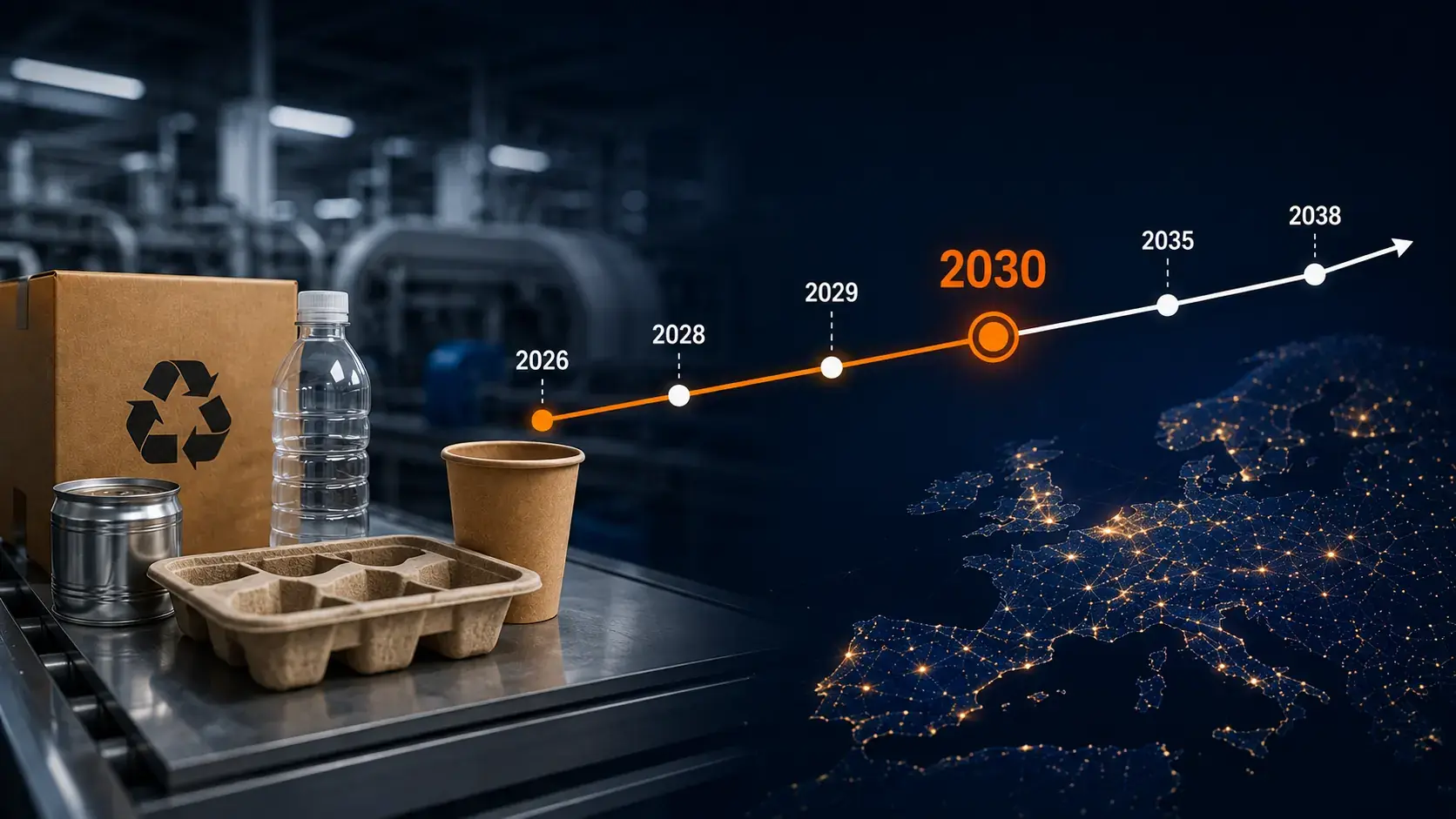
- It arrives in stages. The organisational part has applied since August 2026, the substantive design and labelling requirements run through to 2038.
Key point: the PPWR turns a waste report into product law with a conformity record per packaging type.
What changes compared with the old Packaging Directive
Under Directive 94/62/EC the centre of gravity was the volume you placed on the market and the fee that followed. Registration, volume reporting and compliance scheme participation stay in place under the PPWR. What is new sits next to them, not inside them.
| Topic | Under the old Directive | Under the PPWR |
|---|---|---|
| Legal form | Directive, transposed into national law in 27 different ways | Regulation, directly applicable with the same wording everywhere |
| Core question | How much packaging do you place on the market, and what does disposal cost? | Does this packaging type meet the requirements, and can you prove it? |
| Central document | Registration and volume reporting | Technical documentation and EU declaration of conformity per packaging type, for the requirements that applyArticles 15 and 39, Annexes VII and VIII |
| Data basis | Material type and weight per reporting period | Components, materials, individual weights, methods, test reports and versions per packaging |
| Oversight | National registers and compliance schemes | Market surveillance on top, with electronic replies within ten daysArticle 15(10) |
National law has not gone away. Member States still run their registers and compliance schemes, and Germany, for example, replaced its Packaging Act with the Verpackungsrecht-Durchführungsgesetz on 12 August 2026 while keeping the established structures. If you sell into several markets, treat the PPWR as the common floor and the national rules as what sits on top of it.
One shift hits retail harder than brand owners. The German packaging register, the Zentrale Stelle Verpackungsregister, has made clear that responsibility for own-brand packaging and direct imports cannot be pushed onto suppliers or contract fillers, and that no transition period is provided for.
Key point: volume reporting and scheme participation remain, and conformity documentation per packaging type comes on top.
Which obligations have applied since 12 August 2026
12 August 2026
Date of application of Regulation (EU) 2025/40 in all EU Member States. EUR-Lex
A common assumption is that the PPWR only gets serious in 2028 or 2030. That holds for the design and labelling requirements, not for the record-keeping and substance duties. These six points are already in force:
- Conformity assessment, technical documentation and EU declaration of conformity per packaging type, before the packaging is placed on the market (Articles 15, 38 and 39). The record covers the requirements in Articles 5 to 12 that already apply. For recyclability under Article 6 the procedure only bites once the delegated acts are in force, so you do not have to evidence a performance grade that has no criteria yet.
- Substance restrictions under Article 5, including the combined limit for heavy metals and the limits for PFAS in food contact packaging (25 ppb per individual substance, 250 ppb in total, 50 ppm total PFAS).
- Identification and traceability: name, registered trade name or trademark and address of the manufacturer on the packaging or in the accompanying documents (Article 15(6)), plus an identification mark for type, batch or serial number.
- Claims about the packaging: the ban on misleading voluntary information (Article 12(8)) and the requirements for environmental claims (Article 14).
- Registration and volume reporting in each Member State, continued in Germany through the packaging register (Articles 44 and 45).
- Ability to respond: on a reasoned request from a competent national authority, the necessary information including the technical documentation has to be provided electronically, as a rule within ten days (Article 15(10)).
Record retention comes on top: five years for single-use packaging, ten years for reusable packaging. What we see at customers is that the ten-day deadline is where it breaks first. The evidence usually exists somewhere, spread across procurement, quality assurance and three mailboxes. Pulling it together in ten days and tying it to the right packaging version is the actual job.
Key point: the record-keeping duties for what already applies, and the substance limits, are live now rather than in 2030.
Which requirements follow in stages
The substantive design and labelling requirements depend on delegated and implementing acts the Commission has yet to adopt. That is why the regulation so often carries a double deadline: a fixed date, or a period after the relevant act enters into force, whichever is later.
Which acts already exist and how the Commission reads individual points is tracked in the Commission FAQ on the PPWR, published on 3 August 2026 and reflecting the position at the end of July 2026. For the status of the secondary acts it is the most reliable public source.
| Requirement | From when | What it means |
|---|---|---|
| Harmonised labelling of material compositionArticle 12 | 12 August 2028, or 24 months after the implementing acts enter into force, whichever is later | Material data has to be available in a form the prescribed label can be generated from |
| Labelling and data carrier for reusable packagingArticle 12(2) | 12 February 2029, or 30 months after the implementing act enters into force, whichever is later | Applies to reusable packaging only, and the detail is not settled yet |
| Minimisation of weight and volumeArticle 10, Annex IV | 1 January 2030 | Packaging must be no larger or heavier than its function requires, documented against the criteria in Annex IV |
| Recyclability by performance gradeArticle 6 | 1 January 2030, or 24 months after the delegated acts enter into force, whichever is later | Further tightening in 2035 and 2038, assessed by packaging category |
| Minimum recycled content in plastic packagingArticle 7 | 1 January 2030, or three years after the implementing act enters into force, whichever is later | Applies to plastic components, including evidence of method and origin |
| Empty space ratio in grouped, transport and e-commerce packagingArticle 24 | 1 January 2030, or three years after the implementing act enters into force, whichever is later | No more than 50% empty space, relevant above all in e-commerce |
| Ban on certain single-use packaging formatsArticle 25, Annex V | 1 January 2030 | Applies to defined uses, so each range needs checking |
Above all of this sits Article 43: packaging waste per capita is to fall by 5% by 2030, 10% by 2035 and 15% by 2040 against 2018. That is an obligation on Member States rather than a figure you report, but it explains the pressure that reaches you through national instruments.
Key point: almost every design requirement carries a double deadline, so the date in the regulation is only the earliest it can bite.
Who carries the obligations
The PPWR spreads obligations across roles, and the most important distinction is between two words that sound interchangeable in everyday use. The manufacturer under Article 3(1)(13) is responsible for the conformity of the packaging. The producer under Article 3(1)(15) carries extended producer responsibility in a given Member State, which means registration, volume reporting and financing waste management. The two roles often sit with the same company, but not always.
Watch the wording when you compare language versions. In the German text the conformity role is called Erzeuger and the extended producer responsibility role is called Hersteller, which is close to the opposite of the English pairing. Teams working across both versions regularly assign the wrong duties because of it.
The European Commission guidance on the PPWR (adopted on as C(2026) 3702 final, published in the Official Journal as C/2026/3084) settles a lot of arguments with one sentence: in a supply chain there is only ever one manufacturer. For sales and grouped packaging that is typically the filler, often the brand owner as well. For transport, service and primary production packaging it can instead be the company that produces the packaging, unless the buyer marks it clearly with its own name or trademark.
How the roles fall out per business model is set out on the overview page on the EU Packaging Regulation.
Key point: the manufacturer answers for conformity, the producer for waste responsibility. Contracts do not move either role.
Where the PPWR meets the Digital Product Passport
The PPWR does not require a separate passport for packaging. At one point, though, it reaches straight into your data architecture. Where other Union law requires a data carrier for the packaged product, in particular a Digital Product Passport, Article 12(5) requires a single shared data carrier for the necessary product and packaging information. The two must stay easy to tell apart.
The precision matters here: what is required is a shared data carrier, not a shared system. Two separate QR codes on the same packaging do not meet it. Behind the carrier the data sources may stay technically separate, as long as the output comes together.
Two further signals point the same way. Article 44(14) provides for open standards, machine readability and portability without vendor lock-in in the future registration and reporting formats. And extended producer responsibility fees may in future be modulated by recyclability (Article 6(8)) and, for plastic packaging, by recycled content (Article 7(7)). Both are options rather than duties, and how they are used is left to Member States and schemes. Both only work with packaging data you can rely on.
Build that data properly now and you will not have to retrofit it into the Digital Product Passport later.
Key point: the PPWR asks for no packaging passport, but for packaging data that can feed a shared data carrier.
What to do over the next few weeks
Five steps take you from the summary into implementation. The first two need no software, just two hours with procurement, sales and compliance in one room.
- Take stock of your packaging portfolio. List every packaging type separately for each product line: sales, grouped, transport, e-commerce and service packaging.
- Record your role per packaging type and market. Check whose brand the packaging goes to market under, and who first makes the packaged product available in each Member State.
- Set up conformity documentation per packaging type. Collect the description, intended use, drawings, materials, individual weights, methods applied, assessments and test reports required by Annex VII.
- Start the supplier request. Ask your packaging suppliers for the information and documents required by Article 16, and agree the format and the frequency in which they arrive.
- Build the ability to respond. Define who receives an authority request in your organisation, and test once without an occasion whether the complete records for one packaging type can be produced electronically within ten days.
Step five is uncomfortable, which is exactly why it is worth doing. In one afternoon it tells you whether your filing holds up or whether you will be improvising when the first real request lands.
Key point: stocktake and role check cost two hours, the dry run of an authority request shows your real maturity.
The PPWR in numbers
12 Aug 2026
Date of application of Regulation (EU) 2025/40 in all Member States (EUR-Lex)
10 days
Deadline for the electronic reply to an authority on a reasoned request (Article 15(10))
1 manufacturer
per supply chain (Commission guidance, C(2026) 3702 final, Official Journal notice C/2026/3084)
5 and 10 years
Retention of the technical documentation for single-use and for reusable packaging
15%
Target reduction of packaging waste per capita by 2040 against 2018 (Article 43)
No grace period
Responsibility for own brands and direct imports cannot be pushed onto suppliers (Zentrale Stelle Verpackungsregister, April 2026)
Key point: the hard numbers in the PPWR today are deadlines and evidence rules, not material quotas.
Implementation with Narravero
Narravero operates an end-to-end DPP platform. More than 200 enterprise customers across more than 12 industries use it, it processes 300 million DPP accesses per month, EU-hosted and GDPR-compliant.
For the PPWR that means packaging master data, supplier evidence, packaging versions, product assignments and market-specific reporting data run together in one controlled structure. Every packaging version gets a unique identity, every piece of evidence a source, a validity and an approval status. When a supplier changes material, weight or plant, the products and markets affected become visible instead of being hunted for in spreadsheets. For an authority request it means the records for one packaging type can be exported as a package.
Thomas Rödding, founder and CEO of Narravero, is personally involved as Co-Chair of CEN-CENELEC JTC 24 and as Vice Chairman at DIN, the bodies shaping the technical framework for the Digital Product Passport in Europe.
Key point: for most companies the PPWR is not a materials question but a question of how their data is ordered.
Frequently asked questions about the PPWR
What is the PPWR?
The PPWR is the EU Packaging and Packaging Waste Regulation, formally Regulation (EU) 2025/40. It replaces Packaging Directive 94/62/EC and has applied directly in all Member States since 12 August 2026.
What does PPWR stand for?
PPWR stands for Packaging and Packaging Waste Regulation. Its predecessor was the PPWD, the Packaging and Packaging Waste Directive, which was a directive rather than a regulation.
What does the PPWR actually regulate?
The PPWR sets requirements for the packaging itself, covering substances, minimisation, recyclability, recycled content and labelling, together with the records that prove compliance and the extended producer responsibility obligations including registration and volume reporting.
Which PPWR obligations have applied since 12 August 2026?
Since the date of application you need a conformity assessment, technical documentation and an EU declaration of conformity per packaging type, each covering the requirements that already apply, plus the substance restrictions under Article 5, the details identifying the manufacturer, registration and volume reporting in each Member State, and electronic replies to authorities within ten days as a rule.
What is the difference between a manufacturer and a producer under the PPWR?
The manufacturer under Article 3(1)(13) is responsible for the conformity of the packaging, which means assessment, technical documentation and the EU declaration of conformity. The producer under Article 3(1)(15) carries extended producer responsibility in a given Member State, which means registration, volume reporting and financing waste management. One company often holds both roles, but not always.
When does harmonised labelling under the PPWR start to apply?
Harmonised labelling of material composition under Article 12 applies from 12 August 2028, or 24 months after the relevant implementing acts enter into force, whichever is later.
When does packaging have to be recyclable under the PPWR?
The market access criteria for design for recycling under Article 6 apply from 1 January 2030, or 24 months after the delegated acts enter into force, whichever is later. Further tightening follows in 2035 and 2038. Until then, recyclability is not part of the conformity assessment under Article 38.
How long must the technical documentation be kept?
The technical documentation must be kept for five years for single-use packaging and for ten years for reusable packaging.
What does the PPWR have to do with the Digital Product Passport?
The PPWR does not require a separate passport for packaging. Where other Union law requires a data carrier or a Digital Product Passport for the packaged product, Article 12(5) requires a single shared data carrier for the necessary product and packaging information.
Does the PPWR apply to companies based outside the EU?
Yes. The PPWR applies to packaging placed on the EU market regardless of where the company is established. Without an establishment in the target Member State, an authorised representative for extended producer responsibility is typically required, and the importer or distributor may take on roles of their own.
What happens if the documentation is missing when an authority asks?
The competent authority can request the necessary information including the technical documentation. Where packaging is not compliant, the manufacturer has to take corrective action immediately and, if needed, withdraw it from the market. Without registration or compliance scheme participation, the packaged products concerned cannot be sold in that market.